Sunday, July 21, 2013

Call for papers: 2013 International Conference on Environment Pollution and Prevention (ICEPP 2013) (Deadline: 1 Aug 2013)


ICEPP 2013 : 2013 International Conference on Environment Pollution and Prevention


Link: http://www.icepp.org/
 
WhenOct 7, 2013 - Oct 8, 2013
WhereMelaka, Malaysia
Submission DeadlineAug 1, 2013
Notification DueAug 15, 2013
Final Version DueAug 31, 2013
Categories    environment   health   industry applications   sustainability

Call For Papers
The 2013 International Conference on Environment Pollution and Prevention (ICEPP 2013) is the premier forum for the presentation of technological advances and research results in the fields of Environment Pollution and Prevention. ICEPP 2013 will bring together leading engineers and scientists in Environment Pollution and Prevention from around the world.

Topics of interest for submission include, but are not limited to:

International Conference on Environment Pollution and Prevention
Air pollution and treatment
Biofuels
Desalination
Energy Management
Environmental Education Programs
Environmental Protection
Environmental Risk Assessments
Environmental Safety Regulations
Environmental Sustainability and Development
Green Manufacturing and Technologies, Pollution Prevention
Greenhouse Effect, Global Warming, and Climate Change
Groundwater Issues
Impact of Industrialization on the Environment
Nanotechnology Impacts on Environment
Oil Spills
Pollution and Health Issues
Renewable and Non-Renewable Energies
Soil Pollution and Treatment
Wastewater Management and Treatment
Water Pollution and Treatment

All ICEPP 2013 papers will be published in the International Journal of Environmental Science and Development (IJESD, ISSN:2010-0264), and all papers will be included in the Engineering & Technology Digital Library, and indexed by EBSCO, CABI, DOAJ, WorldCat, Google Scholar, Cross ref, ProQuest and sent to be reviewed by Ei Compendex and ISI Proceedings.

Submission Methods 

1. https://www.easychair.org/account/signin.cgi?conf=icepp2013; ( .pdf)

If you can't login the submission system, please try to submit through method 2.

2. Email: icepp@cbees.net. ( .pdf and .doc) 

For more information: 
http://www.wikicfp.com/cfp/servlet/event.showcfp?eventid=30756&copyownerid=13881

Publications: Investment Incentives for Renewable Energy in Southeast Asia: Case study of Viet Nam » Nam Pham Khanh, Quan Nguyen Anh, Binh Quan Minh Quoc, IISD, 2012. (Jul 2013)

IISD Publications Centre

Investment Incentives for Renewable Energy in Southeast Asia: Case study of Viet Nam

» Nam Pham Khanh, Quan Nguyen Anh, Binh Quan Minh Quoc, IISD, 2012.Paper, 33 pages, copyright: IISD
Energy markets around the world face many challenges. Conventional supplies of fossil fuel reserves are becoming increasingly scarce, leading to rising prices. At the same time, concerns over climate change are growing, increasing the urgency for countries to decouple greenhouse gas emissions from economic growth. All of these pressures have greatly raised the profile of renewable energy technologies (RETs), with governments now commonly providing a range of support frameworks and incentives to attract investment.
This report assesses investment incentives for renewable energy in Viet Nam. It focuses on small hydro, wind, solar, biogas, and biomass resources. Through an analysis of the incentives available for these technologies, and drawing on insights from representatives from governments and industry, it suggests some initial findings on the extent to which Viet Nam’s investment incentives for renewable energy are effective and affordable, and identifies further research that could usefully be conducted in this area.

The analysis is part of a series of reports that aim to conduct an exploratory assessment of such incentives in developing countries around the world.

Paper


New Books: Water Governance for Sustainable Development Approaches and Lessons from Developing and Transitional Countries By Stefano Farolfi (1 Jun 2013)

Water Governance for Sustainable Development

Approaches and Lessons from Developing and Transitional Countries

By Stefano Farolfi

Edited by Sylvain Perret, Rashid Hassan

Published 1st June 2013 by Routledge – 320 pages
Descriptions:
Good management of water resources - universally identified as a key aspect of poverty reduction, agriculture and food security - has proven, in practice, as difficult to achieve as it is eagerly sought. This book, edited and authored by leading authorities on water resource management, examines the recent changes in governance, institutions, economics and policies of water, covering developing, transitional and developed countries, with special emphasis on southern African case studies. The book examines how water policies, institutions and governance have shifted in recent years from supply-driven, quantitative, centrally controlled management to more demand-sensitive, decentralized, participatory approaches. Such a move often also implies cost recovery principles, resource allocation among competing sectors, and privatization. The case studies demonstrate that the new policies and legal frameworks have been difficult to implement and often fall short of initial expectations. Using an accessible multidisciplinary approach that integrates economics, sociology, geography and policy analysis, the book untangles the issues and presents best practices for policy- and decision-makers, governments and regulators, NGOs and user groups, service providers, and researchers. The overall aim is to show how good water governance structures can be developed and implemented for the benefit of all.

Contents:
Introduction 
* Part I
* Understanding Water Institutions: Structure, Environment and Change Process
* Public�Private Partnership in Irrigation and Drainage: The Need for a Professional Third Party Between Farmers and Government 
* Part II
* The Possibility of Trade in Water Use Entitlements in South Africa under the National Water Act of 1998
* Redressing Inequities through Domestic Water Supply: A 'Poor' Example from Sekhukhune, South Africa
* Local Governance Issues after Irrigation Management Transfer: A Case Study from Limpopo Province, South Africa
* Water Management on a Smallholder Canal Irrigation Scheme in South Africa
* Emerging Rules after Irrigation Management Transfer to Farmers
* Crafting Water Institutions for People and Their Businesses: Exploring the Possibilities in Limpopo 
* Part III
* Conflict Analysis and Value-focused Thinking to Aid Resolution of Water Conflicts in the Mkoji Sub-catchment, Tanzania
* Determinants of Quality and Quantity Values of Water for Domestic Uses in the Steelpoort Sub-basin: A Contingent Valuation Approach
* Water Resources and Food Security: Simulations for Policy Dialogue in Tanzania
* How More Regulated Dam Release Can Improve the Supply from Groundwater and Surface Water in the Tadla Irrigation Scheme in Morocco
* Impact of Institutional Changes within Small-scale Groundwater Irrigated Systems: A Case Study in Mexico
* Local Empowerment in Smallholder Irrigation Schemes: A Methodology for Participatory Diagnosis and Prospective Analysis
* Role-playing Game Development in Irrigation Management: A Social Learning Approach
* Support to Stakeholder Involvement in Water Management Circumventing Some Participation Pitfalls

New Books: International Regimes in China Domestic Implementation of the International Fisheries Agreements By Gianluca Ferraro (15 Jul 2013)

International Regimes in China

Domestic Implementation of the International Fisheries Agreements

By Gianluca Ferraro

Published 15th July 2013 by Routledge – 164 pages
Descriptions:
According to the Food and Agriculture Organization (FAO) of the United Nations, more than 80% of world’s fish stocks are fully exploited, over-exploited, depleted, or recovering from depletion. Although several international agreements have promoted more responsible fisheries, coastal states have usually maintained national policies that enable higher harvest levels rather than greater conservation of fish stocks, and international agreements for more responsible fisheries have generally experienced a weak domestic implementation.
Among the major coastal fishing states, China constitutes the largest fish producer and main exporter in the world, and therefore presents a fascinating case-study for the domestic implementation of international fisheries agreements. This book investigates the degree to which China has complied with the international agreements it has signed, and asks why it is failing to meet expectations. Crucially, it calls for greater emphasis on the political, rather than technical, issues involved in the implementation of international regimes. In turn, it examines how understanding the case of China can help us to develop solutions for improved international compliance in the future.
Providing an improved understanding of the implementation of international regimes, alongside an in-depth study of China’s political system, policy-making and compliance, this book will be of great interest to students and scholars of Chinese studies, international relations, public policy, and international law and environmental studies. It will also be useful for policy makers working in the fields of environmental regulation and fisheries management.

Contents:
Introduction
1. Fisheries between international and national policy-making
2. Implementation in theory
3. The political system of the People’s Republic of China
4. China’s power centres and authority relations
5. Fisheries resources management and fishing licenses
6. Fisheries resources management and fishing quotas
7. Marine environmental protection and MPAs
8. Domestic implementation of the international fisheries agreements in China
9. International regimes in China
10. Conclusions

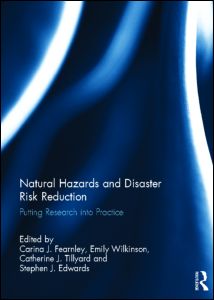
New Books: Natural Hazards and Disaster Risk Reduction Putting Research into Practice Edited by Carina Fearnley, Emily Wilkinson, Catherine J. Tillyard,Stephen J. Edwards (19 Jul 2013)

Natural Hazards and Disaster Risk Reduction

Putting Research into Practice

Edited by Carina Fearnley, Emily Wilkinson, Catherine J. Tillyard,Stephen J. Edwards

Published 19th July 2013 by Routledge – 112 pages

Descriptions:
Building upon presentations given during the conference on ‘Disaster Risk Reduction for Natural Hazards: Putting Research into Practice’, held at University College London in November 2009, the articles collected in this book examine how natural hazards research is accessed and used by practitioners and decision-makers, and conversely, how policy and practice inform research.
As with the conference, this book successfully brings together views from humanitarian and development agencies, academia, business, government and funding bodies. It is rare to engage such a wide range of sectors in a discussion relating to the issues of disaster risk reduction from a natural hazards perspective, and the book captures this interaction and the resultant exchange of ideas, thus providing an insight into how stakeholders respectively undertake or engage with natural hazards research. Collectively, the articles highlight the need for greater dialogue, understanding and collaboration between all these sectors if research is to be made relevant and generate significant impact on risk reduction policy and practice. There is an urgent requirement to better understand the respective needs, ways of working, project timescales and funding mechanisms for disaster risk reduction, as well as the challenges posed by institutional and organizational structures and functions. These issues must be overcome to ensure that ultimately, and most significantly, discussions turn into positive practical actions so that research on natural hazards is relevant and applicable. The book represents a step in that journey.
This book was published as a special issue of Environmental Hazards.
Contents:
  1. Preface 
  2. Culture and disaster risk reduction: Lessons and opportunities 
  3. Disaster-induced migration: Assessing the impact of extreme weather events on livelihoods
  4. Building livelihoods to reduce risk among the most marginalized in urban areas: Strategic approaches from Dhaka 
  5. Evaluating critical links in early warning systems for natural hazards 
  6. ‘Community’ perceptions of a disaster risk reduction intervention at Santa Ana (Ilamatepec) Volcano, El Salvador 
  7. Why ‘small is beautiful’ in municipal disaster risk reduction: Evidence from the Yucatán peninsula, Mexico 
  8. Conference summary on disaster risk reduction for natural hazards: Putting research into practice

Thursday, July 18, 2013

Events: World Water Week: Eye on Asia organized by ADB from 1-6 Sep 2013

World Water Week: Eye on Asia
Stockholm, Sweden : 1 September 2013 - 6 September 2013

Description
Since 2008 during World Water Week, ADB and its partners have been organizing "Eye on Asia," a day-long set of activities that promote a better understanding of water issues in the region and the efforts of governments and development agencies to address them.

World Water Week, hosted and organized by the Stockholm International Water Institute, has been the annual focal point for the globe's water issues since 1991. Each year, World Water Week addresses a particular theme to enable a deeper examination of a specific water-related topic. The theme for 2013 is "Water Cooperation - Building Partnerships."

ADB's Eye on Asia event this year, on Tuesday 3 September, will focus on partnerships for water security with "New players, smarter rules, better outcomes." ADB's Asian Water Development Outlook 2013 shows that water security in much of the region is low and urgent action is required. Eye on Asia will mobilize leading stakeholders from Asia and the Pacific regions to examine different perspectives, identify water management options, and build new partnerships to advance water security for all.

Objectives
Eye on Asia aims to help participants understand how proactive action can move the water security agenda forward in the basins of the region, and that by building bridges between diverse groups, and sometimes conflicting objectives, new synergies can be obtained.

Organizers
Eye on Asia is organized by ADB, Asia-Pacific Water Forum (APWF), International Center for Integrated Mountain Development (ICIMOD), Global Water Partnership (GWP) and WWF.

Participants
Political leaders, government agencies, private sector, civil society, academia, media, development partners and investors will be invited to participate.

Publications: WorldFish Provides Economic Analysis of Adaptation in South-East Asia by WorldFish (18 Jul 2013)

WorldFish Provides Economic Analysis of Adaptation in South-East Asia


WorldFishJuly 2013: WorldFish has released a publication that documents the cross-country economic impacts of three climate hazards, namely typhoons, coastal erosion and saltwater intrusion, as well as the costs of adaptation options and autonomous household responses in three Asian countries.

The report, titled 'Economic Analysis of Climate Change Adaptation Strategies in Selected Coastal Areas in Indonesia, Philippines and Vietnam,' uses a range of qualitative and quantitative methods to document the confluence of risks affecting households. The study finds ecosystem-based approaches for reducing vulnerability to be more effective than hard infrastructure investments. It also stresses that planned adaptation efforts and external assistance reduce the amount of autonomous adaptation undertaken by private actors.

WorldFish is a member of the Consultative Group on International Agricultural Research (CGIAR). [Publication: Economic Analysis of Climate Change Adaptation Strategies in Selected Coastal Areas in Indonesia, Philippines and Vietnam]


For more information: 
http://climate-l.iisd.org/news/worldfish-provides-economic-analysis-of-adaptation-in-south-east-asia/209184/