Showing posts with label risk. Show all posts

Thursday, August 1, 2013

Events: International Symposium on Sustainable Cities: Empowering Local Governments through Capacity Building organized by UNOSD on 26-28 Sep 2013


Event


International Symposium on Sustainable Cities: Empowering Local Governments through Capacity Building


The UN Office for Sustainable Development (UNOSD) will host this international symposium to strengthen dissemination and sharing of good practices and lessons learned on fostering sustainable cities, in recognition of the role of cities in protecting the environment, improving disaster risk reduction (DRR) and resilience and reducing poverty. The symposium aims to identify strategies to strengthen local government institutional and technical capacity to address poverty reduction and slum upgrading, urban development, urban economic growth, urban transport and water and sanitation. The symposium also aims to identify areas for further capacity building and knowledge sharing and to identify innovative financing models to support urban infrastructure. The event will bring together representatives of governments, including and local government and planning officials, UN agencies, multilateral and regional development banks, the private sector and civil society in plenary sessions, working group sessions and panel discussions. The symposium is planned to overlap with the ‘Incheon Sister and Friendly Cities Conference,' which will be held in Incheon on 28 September 2013, and include mayors from cities around the world. The two events will have a joint closing session that will discuss advancing and implementing the sustainable urbanization agenda.


dates: 26-28 September 2013   
venue: Convention Center, SongdoDong   
location: Incheon, Republic of Korea   

For more information: 

Sunday, July 21, 2013

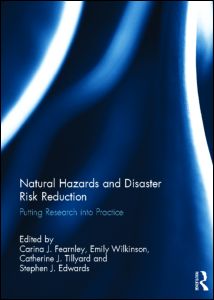
New Books: Natural Hazards and Disaster Risk Reduction Putting Research into Practice Edited by Carina Fearnley, Emily Wilkinson, Catherine J. Tillyard,Stephen J. Edwards (19 Jul 2013)

Natural Hazards and Disaster Risk Reduction

Putting Research into Practice

Edited by Carina FearnleyEmily WilkinsonCatherine J. Tillyard,Stephen J. Edwards

Published 19th July 2013 by Routledge – 112 pages

Descriptions:
Building upon presentations given during the conference on ‘Disaster Risk Reduction for Natural Hazards: Putting Research into Practice’, held at University College London in November 2009, the articles collected in this book examine how natural hazards research is accessed and used by practitioners and decision-makers, and conversely, how policy and practice inform research.
As with the conference, this book successfully brings together views from humanitarian and development agencies, academia, business, government and funding bodies. It is rare to engage such a wide range of sectors in a discussion relating to the issues of disaster risk reduction from a natural hazards perspective, and the book captures this interaction and the resultant exchange of ideas, thus providing an insight into how stakeholders respectively undertake or engage with natural hazards research. Collectively, the articles highlight the need for greater dialogue, understanding and collaboration between all these sectors if research is to be made relevant and generate significant impact on risk reduction policy and practice. There is an urgent requirement to better understand the respective needs, ways of working, project timescales and funding mechanisms for disaster risk reduction, as well as the challenges posed by institutional and organizational structures and functions. These issues must be overcome to ensure that ultimately, and most significantly, discussions turn into positive practical actions so that research on natural hazards is relevant and applicable. The book represents a step in that journey.
This book was published as a special issue of Environmental Hazards.
Contents:
  1. Preface 
  2. Culture and disaster risk reduction: Lessons and opportunities 
  3. Disaster-induced migration: Assessing the impact of extreme weather events on livelihoods
  4. Building livelihoods to reduce risk among the most marginalized in urban areas: Strategic approaches from Dhaka 
  5. Evaluating critical links in early warning systems for natural hazards 
  6. ‘Community’ perceptions of a disaster risk reduction intervention at Santa Ana (Ilamatepec) Volcano, El Salvador 
  7. Why ‘small is beautiful’ in municipal disaster risk reduction: Evidence from the Yucatán peninsula, Mexico 
  8. Conference summary on disaster risk reduction for natural hazards: Putting research into practice

Friday, July 12, 2013

New Books: Managing Adaptation to Climate Risk Beyond Fragmented Responses By Geoff O'Brien, Phil O'Keefe (8 Jul 2013)

Managing Adaptation to Climate Risk

Beyond Fragmented Responses

By Geoff O'BrienPhil O'Keefe

Published 8th July 2013 by Routledge – 218 pages
Descriptions:
Climate change is the single largest threat to the attainment of the Millennium Development Goals (MDGs) and sustainable development. Addressing climate risk is a challenge for all. This book calls for greater collaboration between climate communities and disaster development communities. In discussing this, the book will evaluate the approaches used by each community to reduce the adverse effects of climate change. One area that offers some promise for bringing together these communities is through the concept of resilience. This term is increasingly used in each community to describe a process that embeds capacity to respond to and cope with disruptive events. This emphasizes an approach that is more focused on pre-event planning and using strategies to build resilience to hazards in an adaptation framework. The book will conclude by evaluating the scope for a holistic approach where these communities can effectively contribute to building communities that are resilient to climate driven risks.

Contents:
Introduction
1. The Sustainability Problem
2. The Climate Journey
3. Climate Extremes - Does a Post-normal Approach Make Sense?
4. Disaster Management
5. Adaptation
6. The Concept of Resilience
7. Development
8. Social Capital and Social Learning
9. Conclusion

Sunday, June 30, 2013

New Books: The Role of Ecosystems in Disaster Risk Reduction edited by Fabrice G. Renaud, Karen Sudmeier-Rieux and Marisol Estrella (Jun 2013)

The Role of Ecosystems in Disaster Risk Reduction

Edited by Fabrice G. RenaudKaren Sudmeier-Rieux and Marisol Estrella

1221 – Renaud – Role of Ecosystem _FINAL front cover_web
PUBLICATION DATA:
ISBN-13: 978-92-808-1221-3
LANGUAGE:
English
PAGES:
440
PRICE:
US$40.00
PUBLISHER:
United Nations University Press
PUBLISHED:
June 2013

The increasing worldwide trend in disasters, which will be aggravated by global environmental
change (including climate change), urges us to implement new approaches to
hazard mitigation, as well as exposure and vulnerability reduction. We are, however, faced
with hard choices about hazard mitigation: should we continue to build dikes and walls
to protect ourselves against floods and coastal hazards – though we have seen the limits
of these – or should we consider alternative, ecosystem-based solutions? Ecosystem
management is a well-tested solution to sustainable development that is being revisited
because of its inherent “win–win” and “no-regrets” appeal to address rising disaster and
climate change issues. It is one of the few approaches that can impact all elements of the
disaster risk equation – mitigating hazards, reducing exposure, reducing vulnerabilities
and increasing the resilience of exposed communities. Yet, the uptake of ecosystem-based
approaches for disaster risk reduction (DRR) is slow despite some very good examples of
success stories. Reasons for this are multiple: ecosystem management is rarely considered
as part of the portfolio of DRR solutions because the environmental and disaster
management communities typically work independently from each other; its contribution
to DRR is highly undervalued compared to engineered solutions and thus not attributed
appropriate budget allocations; finally, there are poor science–policy interactions on
ecosystem-based DRR, which have led to unclear and sometimes contradictory scientific
information on the role of ecosystems in DRR.
The aim of this book is to provide an overview of knowledge and practice in the multidisciplinary
field of ecosystem management and DRR to encourage and further develop
dialogues between scientists, practitioners, policymakers and development planners.

About the Editors:

Fabrice G. Renaud is Head of Section at the United Nations University Institute for
Environment and Human Security, Germany. Karen Sudmeier-Rieux is a Researcher at the
Center for Research of the Terrestrial Environment, University of Lausanne, Switzerland.
Marisol Estrella is the Programme Coordinator of the Disaster Risk Reduction Unit,
Post-Conflict and Disaster Management Branch, United Nations Environment Programme,
Switzerland.

Table of Contents:

Part I: Why do ecosystems matter in disaster risk reduction?
The relevance of ecosystems for disaster risk reduction, Fabrice G. Renaud, Karen Sudmeier-Rieux and Marisol Estrella
Ecosystem-based disaster risk reduction (Eco-DRR): An overview, Marisol Estrella and Nina Saalismaa
Part II: Ecosystems and coastal disaster risk reduction
Investigating the performance of coastal ecosystems for hazard mitigation, Sam S.L. Hettiarachchi, Saman P. Samarawickrama, Harindra J.S. Fernando, A. Harsha R. Ratnasooriya, N.A. Kithsiri Nandasena and Srimal Bandara
Bioshields: Mangrove ecosystems as resilient natural coastal defences, Carmen Lacambra, Daniel A. Friess, Tom Spencer and Iris Möller
Integrating the role of ecosystems in disaster risk and vulnerability assessments: Lessons from the Risk and Vulnerability Assessment Methodology Development Project (RiVAMP) in Negril, Jamaica,
Pascal Peduzzi, Adonis Velegrakis, Marisol Estrella and Bruno Chatenoux
Increasing the resilience of human and natural communities to coastal hazards: Supporting decisions in New York and Connecticut, Michael W. Beck, Ben Gilmer, Zach Ferdaña, George T.
Raber, Christine C. Shepard, Imen Meliane, Jeffrey D. Stone, Adam W. Whelchel, Mark Hoover and Sarah Newkirk
A coastal adaptation strategy for the City of Cape Town: An ecosystem-based management approach towards risk reduction, Darryl Colenbrander, Penny Price, Gregg Oelofse and Sakhile Tsotsobe
Lessons from local initiatives on ecosystem-based climate change work in Tonga, Stavros Mavrogenis and Ilan Kelman
Part III: Water resources management for disaster risk reduction
Good flood, bad flood: Maintaining dynamic river basins for community resilience, Pieter van Eijk, Chris Baker, Romana Gaspirc and Ritesh Kumar
Utilizing integrated water resources management approaches to support disaster risk reduction, James Dalton, Radhika Murti and Alvin Chandra
The matter is not if, but when and where: The role of capacity development in disaster risk reduction aiming for a sustainable water supply and sanitation, Madeleine Fogde, Luis Macario and Kirsten Carey
Part IV: Sustainable land management for disaster risk reduction
12 The role of vegetation cover change in landslide hazard and risk, Maria Papathoma-Koehle and Thomas Glade
Protection forests: A key factor in integrated risk management in the Alps,André Wehrli and Luuk Dorren
Forest cover and landslide trends: A case study from Dolakha District in central-eastern Nepal, 1992–2009, Stéphanie Jaquet, Karen Sudmeier-Rieux, Marc-Henri Derron and Michel Jaboyedoff
Part V: Policy, planning and future perspectives
Reducing vulnerability: The role of protected areas in mitigating natural disasters, Nigel Dudley, Kathy MacKinnon and Sue Stolton
Urban disaster risk reduction and ecosystem services, Lorenzo Guadagno, Yaella Depietri and Urbano Fra Paleo
Applying environmental impact assessments and strategic environmental assessments in disaster management, Anil Kumar Gupta and Sreeja S. Nair
Opportunities, challenges and future perspectives for ecosystem-based disaster risk reduction, Marisol Estrella, Fabrice G. Renaud and Karen Sudmeier-Rieux
For more information: 

Saturday, June 29, 2013

New Books: Risk Edited by Ragnar Lofstedt, Frederic Bouder (25 Jun 2013)

Risk

Edited by Ragnar LofstedtFrederic Bouder

Published 25th June 2013 by Routledge – 1,808 pages

Descriptions:
Can we better predict or mitigate the consequences of natural disasters, such as earthquakes and hurricanes? Can we reduce the number of oil spills? And what should be done to clean up the mess when something does goes wrong? Why are people concerned about nuclear plants, but so reckless when they go skiing, or when they drive their motor cars? And how can we ensure that experts and ordinary citizens exchange meaningful information about hazards?
Over the past fifty years or so, eminent scholars from the decision sciences, geography, sociology, anthropology, and many other fields, have offered useful pointers towards finding an answer to these and other crucial questions. Their prolific and converging efforts have established Risk Analysis as a vivid new discipline, a discipline which this new Routledge collection enables users to discover—or to understand better.
The collection conveys essential lessons about how risks can be better assessed. Sophisticated models about the probability and magnitude of harms have been developed and tested in a variety of fields, for example, by engineers trying to build safer plants, or by toxicologists trying to understand the pathways of pollutants. The materials gathered here also help us to understand how powerful perception drivers shape our views of different risks and, as a consequence, how risk communication may be best conducted. Risk also brings together and makes sense of a body of knowledge that has allowed the development of specific methods to join together these two crucial elements into a coherent management ‘whole’.
Contents:
Volume 1: Risk Assessment
Volume II: Risk Perception
Volume III: Risk Communication
Volume IV: Risk Management

Wednesday, June 12, 2013

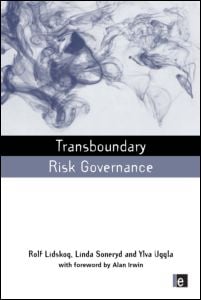
New Books: Transboundary Risk Governance By Rolf Lidskog, Linda Soneryd, Ylva Uggla (1 Jun 2013)

Transboundary Risk Governance

By Rolf LidskogLinda SonerydYlva Uggla

Foreword by Alan Irwin

Published 1st June 2013 by Routledge – 176 pages
Descriptions:
Governing environmental risk, particularly large-scale transboundary risks associated with climate change and pollution, is one of the most pressing problems facing society . This book focuses on a set of key questions relating to environmental regulation: How are activities regulated in a fragmented world - a world of nation states, regulators, domestic and international law and political contests - and one in which a range of actors, such as governments, corporations and NGOs act in order to influence regulations in specific policy areas? How are complex and trans-boundary environmental issues managed? What role does expert knowledge play in regulating this kind of issues? What give rules authority? In short, how do actors try to render an issue governable? Drawing on regulation theory, discourse theory and science and technology studies, and employing original research, the authors analyse the regulation of four kinds of complex and trans-boundary environmental issues: oil protection in the Baltic Sea, mobile phones and radiation protection, climate change adaptation and genetically modified crops. The outcomes include insights for policymakers, regulators and researchers into how dominant frames are constructed, legitimate actors are configured and authority is established. This in turn exposes the conditions for, and possibility of, developing regulation, making authoritative rules and shaping relevant knowledge in order to govern complex environmental risks.

Contents:
Preface Foreword by Alan Irwin 
1. Regulating Risk in a Fragmented World
2. Making Rules and Shaping Knowledge
3. Mobile Telephony and Radiation Protection: Regulating Risk or Local Self-Governance
4. Oil Transports in the Baltic Sea: Environmental Protection and the Freedom of the High Seas
5. Climate Change Adaptation: Regulation under Formation
6. Regulating Coexistence: The Creation of New Discursive Sites for the Battle over GM Crops
7. Co-Producing Frames, Actors and Knowledges References