Showing posts with label research. Show all posts

Sunday, July 21, 2013

New Books: Natural Hazards and Disaster Risk Reduction Putting Research into Practice Edited by Carina Fearnley, Emily Wilkinson, Catherine J. Tillyard,Stephen J. Edwards (19 Jul 2013)

Natural Hazards and Disaster Risk Reduction

Putting Research into Practice
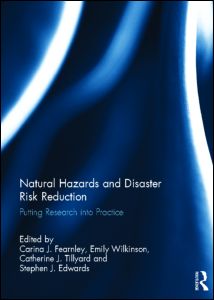
Edited by Carina Fearnley, Emily Wilkinson, Catherine J. Tillyard,Stephen J. Edwards

Published 19th July 2013 by Routledge – 112 pages

Descriptions:
Building upon presentations given during the conference on ‘Disaster Risk Reduction for Natural Hazards: Putting Research into Practice’, held at University College London in November 2009, the articles collected in this book examine how natural hazards research is accessed and used by practitioners and decision-makers, and conversely, how policy and practice inform research.
As with the conference, this book successfully brings together views from humanitarian and development agencies, academia, business, government and funding bodies. It is rare to engage such a wide range of sectors in a discussion relating to the issues of disaster risk reduction from a natural hazards perspective, and the book captures this interaction and the resultant exchange of ideas, thus providing an insight into how stakeholders respectively undertake or engage with natural hazards research. Collectively, the articles highlight the need for greater dialogue, understanding and collaboration between all these sectors if research is to be made relevant and generate significant impact on risk reduction policy and practice. There is an urgent requirement to better understand the respective needs, ways of working, project timescales and funding mechanisms for disaster risk reduction, as well as the challenges posed by institutional and organizational structures and functions. These issues must be overcome to ensure that ultimately, and most significantly, discussions turn into positive practical actions so that research on natural hazards is relevant and applicable. The book represents a step in that journey.
This book was published as a special issue of Environmental Hazards.
Contents:
  1. Preface 
  2. Culture and disaster risk reduction: Lessons and opportunities 
  3. Disaster-induced migration: Assessing the impact of extreme weather events on livelihoods
  4. Building livelihoods to reduce risk among the most marginalized in urban areas: Strategic approaches from Dhaka 
  5. Evaluating critical links in early warning systems for natural hazards 
  6. ‘Community’ perceptions of a disaster risk reduction intervention at Santa Ana (Ilamatepec) Volcano, El Salvador 
  7. Why ‘small is beautiful’ in municipal disaster risk reduction: Evidence from the Yucatán peninsula, Mexico 
  8. Conference summary on disaster risk reduction for natural hazards: Putting research into practice

Sunday, July 7, 2013

Call for Abstracts Open – IMBER Open Science Conference 2014 (Deadline: 15 Jan 2014)

Call for Abstracts Open – IMBER Open Science Conference 2014
OSC2014-banner
Integrated Marine Biogeochemistry and Ecosystem Research (IMBER)
Open Science Conference
23-27 June 2014, Bergen, Norway
“Future Oceans – Research for marine sustainability:
multiple stressors, drivers, challenges and solutions
”
The Integrated Biogeochemistry and Ecosystem Research (IMBER) Project will convene its Open Science Conference from 23-27 June 2014 in Bergen, Norway, with the goals of:
·  highlighting research results from the IMBER project and activities,
·  promoting integrated synthesis of IMBER research, and
·  developing a science plan and implementation strategy for the next phase of IMBER research.
The Call for Abstracts for the IMBER OSC 2014 is now open!  Deadline for abstract submission: 15 January 2014.
Contributions to the IMBER OSC 2014 are welcome from all marine and oceanographic communities!
IMBER IPO : imber@imr.no
For more information: 
http://www.apn-gcr.org/2013/07/01/call-for-abstracts-open-imber-open-science-conference-2014/

Sunday, June 30, 2013

Research: Growth in crop yields inadequate to feed the world by 2050 (20 Jun 2013)

Growth in crop yields inadequate to feed the world by 2050 – research

Agriculture productivity not rising fast enough to meet the needs of a rapidly growing population
Thursday 20 June 2013 17.21 BST guardian.co.uk,
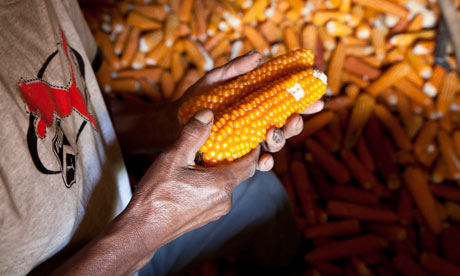
Maize : Close up of the hands of a male Mayan, Guatemalan farmer holding corn or maizeIf the world is to grow enough food for the projected global population in 2050, agricultural productivity will have to rise by at least 60%, and may need to more than double, according to researchers who have studied global crop yields.
They say that productivity is not rising fast enough at present to meet the likely demands on agriculture.
The researchers studied yields of four key staple crops – maize, rice, wheat and soybeans – and found they were increasing by only about 0.9% to 1.6% a year. That would lead to an overall increase of about 38% to 67% by 2050, which would only be enough to feed the population if the lower end of the estimate of yields needed and the maximum yield increase turns out to be the case.
It also does not take into account other factors, such as climate change, which the World Bank said this week could lead to massive food shortages in many areas as soon as the 2030s.
The study's findings are also likely to fuel debate over the efficacy of genetically modified crops, which some scientists have argued may be needed in future to feed the rapidly growing global population, which is expected to reach at least 9 billion by 2050.
Deepak Ray, who led the new research, said that some countries were faring far worse than others. For instance, in Guatemala, the productivity of the maize agriculture is declining, while the population is growing.
The slow increase in agricultural productivity around the world stands in marked contrast to the "green revolution" that led to a huge increase in crop yields in Asia in the 1960s to 1970s, with the widespread use of new artificial fertilisers, pesticides and growing techniques. The green revolution enabled high population growth and sparked unprecedented economic growth in many Asian countries. Signs that its effects have petered out could be a warning that future population growth may be harder to accommodate.
There is also a danger that large swathes of pristine land — including forests — could be cleared for agriculture to compensate for the slow growth in yields, with potentially damaging effects on the climate and on ecosystems. Fertile agricultural land is at a premium in most countries, and overuse, water scarcity and soil degradation are taking further tolls.
However, the authors of the study only examined crop yields — they emphasised that there should be other ways to improve the world's food supply, including increasing efficiency and cutting the massive waste of food that takes place in both developed and developing countries.
Jon Foley, co-author of the paper, said: "Clearly, the world faces a looming agricultural crisis, with yield increases insufficient to keep up with projected demands. The good news is, opportunities exist to increase production through more efficient use of current arable lands and increased yield growth rates by spreading best management practices. If we are to boost production in these key crops to meet projected needs, we have no time to waste."

Saturday, June 29, 2013

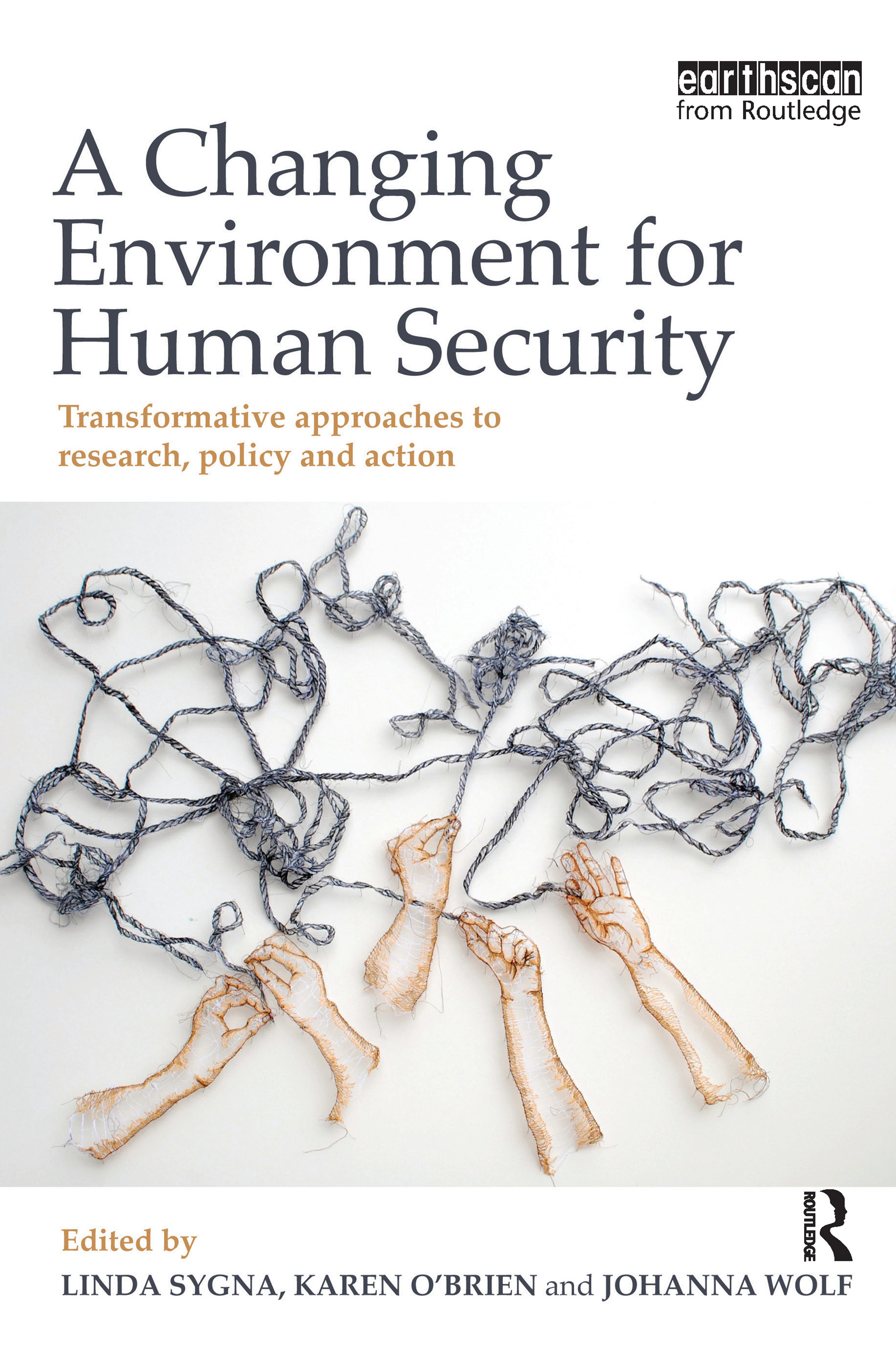
New Books: A Changing Environment for Human Security Transformative Approaches to Research, Policy and Action Edited by Linda Sygna, Karen O'Brien, Johanna Wolf (14 Jun 2013)

A Changing Environment for Human Security

Transformative Approaches to Research, Policy and Action

Edited by Linda Sygna, Karen O'Brien, Johanna Wolf

Descriptions:
Environmental change presents a new context and new opportunities for transformational change. This timely book will inspire new ways of understanding the relationship between environmental change and human security. A Changing Environment for Human Security: Transformative Approaches to Research, Policy and Action both supports and informs a call for new, transformative approaches to research, policy and action. The chapters in this book include critical analyses, case studies and reflections on contemporary environmental and social challenges, with a strong emphasis on those related to climate change. Human thoughts and actions have contributed to an environment of insecurity, manifested as multiple interacting threats that now represent a serious challenge to humanity. Yet humans also have the capacity to collectively transform the economic, political, social and cultural systems and structures that perpetuate human insecurities.
These fresh perspectives on global environmental change from an interdisciplinary group of international experts will inspire readers – whether students, researchers, policy makers, or practitioners – to think differently about environmental issues and sustainability. The contributions show that in a changing environment, human security is not only a possibility, but a choice.

Contents:
Part 1: Reality Check 
Part 2: Breakthrough Conditions
Part 3: Transformations: Past and Future

Thursday, April 11, 2013

Study: Sea Level Rise Threatens Biodiversity in the Pacific by Veterinary University of Vienna in conjunction with Yale University (10 Apr 2013)


Sea Level Rise Threatens Biodiversity in the Pacific

2013-04-10


The predicted rise in sea level in the Pacific in future will lead to heavy losses of habitat that will threaten numerous species, a new study showed on Tuesday.

Conducted by researchers from the Veterinary University of Vienna in conjunction with Yale University, the study is based on model calculations for the Southeast Asian and Pacific Region and is published in the journal Global Change Biology.

The Veterinary University said its model calculations showed a sea level rise of about a meter by the end of the century, and up to 5.5 meters by the year 2500. It also examined more than 12,000 islands and 3,000 vertebrate animal species in the Southeast Asian and Pacific region.

The findings showed that a sea level rise in the region of only one meter would result in the loss of about one percent of land, which would in turn mean 14.7 percent of primarily small islands in the region would be completely flooded, threatening local species.

Should the sea level rise by up to 5.5 meters by 2500 as predicted, a loss of 9.3 percent of habitat in the region would occur, which poses a very significant threat to numerous species including those already endangered, and those who only live on certain islands.

Researchers said their results also reflected the threat a sea level rise poses to island and coastal animal species across the world, the Austrian Press Agency reported.

Saturday, January 26, 2013

Chinese Updates: Residents Near Chinese E-Waste Site Face Greater Cancer Risk (22 Jan 2013)


Residents Near Chinese E-Waste Site Face Greater Cancer Risk

Jan. 22, 2013 — Residents living near an e-waste recycling site in China face elevated risks of lung cancer, according to a recent study co-authored by Oregon State University researchers.

Electronic trash, such as cell phones, computers and TVs, is often collected in dumps in developing countries and crudely incinerated to recover precious metals, including silver, gold, palladium and copper. The process is often primitive, releasing fumes with a range of toxic substances, including polycyclic aromatic hydrocarbons, or PAHs, a group of more than 100 chemicals.
PAHs, many of which are recognized as carcinogenic and linked to lung cancer when inhaled, were the focus of the study. Over the course of a year, researchers collected air samples from two rooftops in two areas in China.
One was in a rural village in the southern province of Guangdong less than a mile from an active e-waste burning site and not surrounded by any industry. The other was Guangzhou, a city heavily polluted by industry, vehicles and power plants but not e-waste.
The scientists concluded that those living in the e-waste village are 1.6 times more likely to develop cancer from inhalation than their urban-dwelling peers.
"In the village, people were recycling waste in their yards and homes, using utensils and pots to melt down circuit boards and reclaim metals," said Staci Simonich, a co-author of the study and a professor of environmental and molecular toxicology at OSU. "There was likely exposure through breathing, skin and food -- including an intimate connection between e-waste and the growing of vegetables, raising of chickens and catching of fish."
The researchers estimated that of each million people in the e-waste area, 15 to 1,200 would develop lung cancer on account of PAHs over their lifetimes, while the likelihood in the city is slightly lower at 9 to 737 per million. These approximations do not include lung cancer caused by smoking.
The study also found that the level of airborne carcinogenic PAHs exceeded China's air quality standards 98 percent of the time in the e-waste area and 93 percent of the time in the city.
The study was published in the journal Environmental Science and Technology. The OSU Superfund Research Program provided assistance for the study. The National Institute of Environmental Health Sciences (NIEHS) and the National Institutes of Health (NIH) provided funding for the study. Eight researchers collaborated on the project, including OSU graduate student Leah Gonzales and scientists from China.


Photo:
Chemist Staci Simonich examines a vial containing air pollutants at her lab at Oregon State University. She co-authored a study that found that residents in an rural Chinese village near an electronic waste dump are 1.6 times more likely to develop lung cancer than their peers in the heavily polluted Chinese city of Guangzhou. (Credit: Photo by Tiffany Woods)

Source:
http://www.sciencedaily.com/releases/2013/01/130123101615.htm?utm_source=feedburner&utm_medium=feed&utm_campaign=Feed%3A+sciencedaily%2Fearth_climate%2Fair_quality+%28ScienceDaily%3A+Earth+%26+Climate+News+--+Air+Quality%29

Sunday, January 6, 2013

Call for papers: AR 2014 : Alternate Routes: A Journal of Critical Social Research: Environmental Intersections: Climate Change, Capitalism and Prospects for Change (31 May 2013 Deadline)


Page Header Logo


AR 2014 : Alternate Routes: A Journal of Critical Social Research: Environmental Intersections: Climate Change, Capitalism and Prospects for Change


Call For Papers


Alternate Routes: A Journal of Critical Social Research, 2014 
Special Issue Call For Papers 

Edited by Carlo Fanelli (Carleton University) and Bryan Evans (Ryerson University) 

Environmental Intersections: Climate Change, Capitalism and Prospects for Change 

For the past five-hundred million years greenhouse gases have fluctuated between 260 and 280 parts per million (ppm). Today, however, they are nearing 400ppm CO2, which is roughly 30 percent higher than previous peaks in volume during interglacial periods. This has led even the World Bank to recently warn that if present trends continue temperatures could rise as much as 6-degress Celsius before the turn of the century, much higher than the generally accepted “safe zone” of 2-degress. From food and water shortages, the destruction of fertile lands, shifts in weather patterns, species extinction and dramatically accelerated glacier melting, environmental crises are intersecting in myriad non-linear and cascading ways. 

This special issue of Alternate Routes is seeking papers that address but are not limited to: In what ways have issues related to environmental degradation taken a backseat to a narrow focus on the “economy” in light of the Great Recession? On what facts do climate change denialists base their claims? How does capitalism limit the space available for substantive environmental reforms? And what are the social, political, cultural and economic consequences of environmental inaction? 

Additional topics may include: ongoing theoretical debates; increasing ocean acidity; species decline; rising carbon emissions; more intense natural disasters; deforestation; desertification; resources extraction; poverty; environmental migration and displacement; “overpopulation”; economy and ecology; the weakening of international and national environmental laws and protections; alternative technologies (e.g. solar, tidal, wind, biofuels); food and water security; lobbying efforts by oil and multi-national companies to counter climate science; alternatives to (neoliberal) capitalism; social justice activism and the prospects for change. 

Submissions must be received no later than May 31, 2013. In addition to your paper, please include an abstract no longer than 300-words and short biography. We strongly encourage interested writers to visit www.alternateroutes.ca for author guidelines and additional information. Submissions must be sent directly to editor@alternateroutes.ca. Publication decisions will be made within 4 to 6 weeks of the submission deadline. 

For all other inquires, please see www.alternateroutes.ca or send an email to the editor@alternateroutes.ca 

Tuesday, July 24, 2012

HK Updates: 渠署研究:綠化牆助降溫7℃


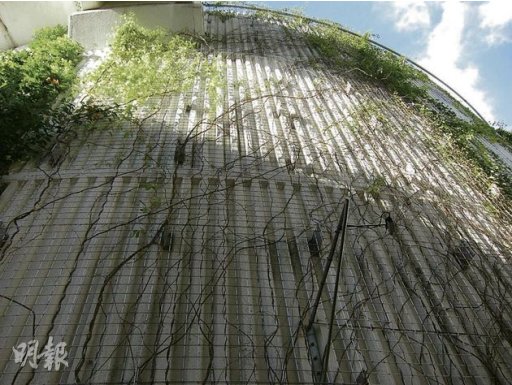
渠務署發現攀緣植物可降低室內溫度,但要小心挑選,如圖中的炮仗花,雖可為建築物降溫7℃,但愈向上生長,接近地面的枝葉愈稀疏。(馬耀森攝)
【明報專訊】渠務署完成垂直綠化研究,發現攀緣植物最高可為建築物降溫7℃。由於每種攀緣植物的生長速度、適應環境能力、降溫效果不同,該署認為挑選合適品種才可發揮最大效果。據了解,發展局計劃制訂垂直綠化植物清單,工務工程可因應攀緣植物特性而決定選種。
渠務署與港大合作,2010年起研究攀緣植物對外牆降溫功效,於沙田污水處理廠沿4個13米高的圓形污泥缸邊緣,種植20種攀緣植物,當中10種設鋼架讓植物附生;另外10種毋須鋼架,植物會自行沿牆壁向上生長。
擬訂清單 讓工務工程選用
結果顯示依靠鋼架生長的植物中,以首冠藤和炮仗花表現較佳,後者更可令牆壁降溫7℃。另港大改良泥土成分,發現攀緣植物生長高度較使用原有土壤高出34%。渠務署副署長徐偉解釋,攀緣植物生長愈密,降溫能力愈高,但要視乎植物是否適合在本港生長。
20種攀緣植物中,只有2、3種如黃金葛及常春藤,因不適應環境枯萎,其餘均可在1.5年內攀爬至13米高的缸頂。但各品種的生長速度參差,例如紫藤和使君子表現最佳,5個月便攀爬到缸頂,另有7個品種生長緩慢。研究發現,部分生長較快的植物如紫藤,因冬天落葉,效果大打折扣,但到夏天會迅速生長,爬滿綠化的牆壁;生長速度較慢的勒杜鵑、葡萄及金銀花,不但四季常綠,由地下至缸頂的葉片密度相若,不會出現較低位置疏落的情况。
徐偉表示,現時政府工務工程沒有參考攀緣植物,業界多使用爬山虎,較為單調,該署會公開測試結果,讓部門因應情况挑選不同的攀緣植物。
不少商場及屋苑採用預製組件,以高密度纖維棉代替泥土,逐件安裝在牆上,雖較靈活,但成本高。不過渠務署發現,大部分攀緣植物,只須沿牆壁邊緣的地下種植,或加設鋼架,便可自行沿牆向上攀爬逾10米。徐偉指研究至今兩年,僅安裝了自動灑水裝置及每年施肥兩次,保養成本有限,大部分植物均可持續生長。
明報記者 馬耀森

Thursday, November 24, 2011

International Conference on Advances in Ecological Research


Date: 19-21 December, 2011
Venue: Maharaja Ganga Singh University


"The biological diversity, land cover, atmospheric composition, climate system etc., are altering at an unprecedented rate. It is critical to understand these interactions so that science can provide a foundation for environmental policy at local, national, and international levels. Losses of biodiversity and changes in ecosystem are some of the most vulnerable issues which need immediate attention. The organization of this Conference is a small step to show our concern towards the losses we are facing and the consequences we are experiencing every day. The gamut of subjects covered by the Conference is comprehensive and wide-scoped.

The Conference will have Plenary Sessions with Distinguished Speakers, Concurrent Technical Sessions on various Thematic areas with Keynote addresses, Selected Oral and Poster presentations."

Organized by Maharaja Ganga Singh University, Bikaner & Nature Conservators.

Official website of ICAER:http://icaer.ac.in/index.php