Sunday, June 30, 2013

World Bank: World's poorest will feel brunt of climate change (19 Jun 2013)

World's poorest will feel brunt of climate change, warns World Bank

Droughts, floods, sea-level rises and fiercer storms likely to undermine progress in developing world and hit food supply
Wednesday 19 June 2013 08.23 BSTguardian.co.uk,
Pakistan floods
Pakistan says the 2010 floods has affected about 20 million people, many of whom lost homes or livelihoods. Photograph: Warrick Page/Getty Images for UN
Millions of people around the world are likely to be pushed back into poverty because climate change is undermining economic development in poor countries, the World Bank has warned.
Droughts, floods, heatwaves, sea-level rises and fiercer storms are likely to accompany increasing global warming and will cause severe hardship in areas that are already poor or were emerging from poverty, the bank said in a report.
Food shortages will be among the first consequences within just two decades, along with damage to cities from fiercer storms and migration as people try to escape the effects.
In sub-Saharan Africa, increasing droughts and excessive heat are likely to mean that within about 20 years the staple crop maize will no longer thrive in about 40% of current farmland. In other parts of the region rising temperatures will kill or degrade swaths of the savanna used to graze livestock, according to the report, Turn down the heat: climate extremes, regional impacts and the case for resilience.
In south-east Asia, events such as the devastating floods in Pakistan in 2010, which affected 20 million people, could become commonplace, while changes to the monsoon could bring severe hardship to Indian farmers.
Warming of at least 2C (36F) – regarded by scientists as the limit of safety beyond which changes to the climate are likely to become catastrophic and irreversible – is all but inevitable on current levels, and the efforts of governments are limited to trying to prevent temperature rises passing over this threshold. But many parts of the world are already experiencing severe challenges as a result of climate change, according to the World Bank, and this will intensify as temperatures rise.
Jim Yong Kim, the bank's president, warned that climate change should not be seen as a future problem that could be put off: "The scientists tell us that if the world warms by 2C – warming which may be reached in 20 to 30 years – that will cause widespread food shortages, unprecedented heatwaves, and more intense cyclones.
"In the near-term, climate change – which is already unfolding – could batter the slums even more and greatly harm the lives and hopes of individuals and families who have had little hand in raising the Earth's temperature."
The development bank is stepping up its funding for countries to adapt to the effects of climate change, and is calling for rich countries to make greater efforts at cutting greenhouse gas emissions.
Rachel Kyte, vice president of the World Bank, said it had doubled its aid for adaptation from $2.3bn (£1.47bn) in 2011 to $4.6bn last year, and called for a further doubling. She said the bank was working to tie its disaster aid and climate change adaptation funding closer together.
Aid from the bank to help poor countries cut their greenhouse gas emissions and pursue environmentally sustainable economic development stands at about $7bn a year, and is backed by about $20bn from regional development banks and other partners.
The report's authors used the latest climate science to examine the likely effects of global warming of 2C to 4C on agriculture, water resources, coastal ecosystems and fisheries, and cities, across sub-Saharan Africa, south and south-east Asia.
Kyte said the effects would be to magnify the problems that developing regions experience. More people would be pushed into slums, with an increased risk of disease. "We are looking at major new initiatives [in] cities; cities need billions of investment in infrastructure, but many developing cities are not really creditworthy," she said.
She pointed to Jakarta, where rising sea levels and decades of pumping freshwater from underground sources beneath and around the city were increasing its vulnerability to flooding. Choices would need to be made soon in many cities on how to stem the likely effects, but Kyte warned that the plans must be future-proof, citing Ho Chi Minh City in Vietnam, which has been forced to rethink its flood preparations despite spending $2bn on them.
Green campaigners emphasised the need to try to avoid 2C of warming, which scientists stay is possible if countries bolster their ambitions to cut greenhouse gas ambitions in the near future.
Stephanie Tunmore, climate campaigner at Greenpeace International, said: "Fossil fuels are being extracted in burned in the name of development and prosperity, but what they are delivering is the opposite.
"Some major impacts from climate change are already unavoidable and rich countries must urgently support the poor and vulnerable to adapt. But massive increases in the future costs of adaptation and damage can only be avoided by investing in a clean energy future now."
The World Bank has come under fire in the past for funding coal-fired power plants in some developing countries. However, it said the move was the result of old policies and was being phased out.
Source:

Research: Growth in crop yields inadequate to feed the world by 2050 (20 Jun 2013)

Growth in crop yields inadequate to feed the world by 2050 – research

Agriculture productivity not rising fast enough to meet the needs of a rapidly growing population
Thursday 20 June 2013 17.21 BST guardian.co.uk,
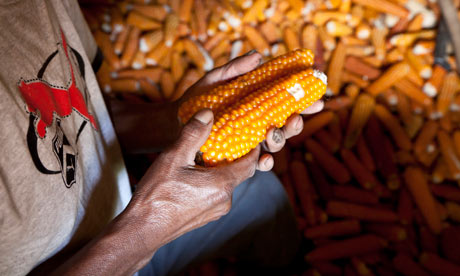
Maize : Close up of the hands of a male Mayan, Guatemalan farmer holding corn or maizeIf the world is to grow enough food for the projected global population in 2050, agricultural productivity will have to rise by at least 60%, and may need to more than double, according to researchers who have studied global crop yields.
They say that productivity is not rising fast enough at present to meet the likely demands on agriculture.
The researchers studied yields of four key staple crops – maize, rice, wheat and soybeans – and found they were increasing by only about 0.9% to 1.6% a year. That would lead to an overall increase of about 38% to 67% by 2050, which would only be enough to feed the population if the lower end of the estimate of yields needed and the maximum yield increase turns out to be the case.
It also does not take into account other factors, such as climate change, which the World Bank said this week could lead to massive food shortages in many areas as soon as the 2030s.
The study's findings are also likely to fuel debate over the efficacy of genetically modified crops, which some scientists have argued may be needed in future to feed the rapidly growing global population, which is expected to reach at least 9 billion by 2050.
Deepak Ray, who led the new research, said that some countries were faring far worse than others. For instance, in Guatemala, the productivity of the maize agriculture is declining, while the population is growing.
The slow increase in agricultural productivity around the world stands in marked contrast to the "green revolution" that led to a huge increase in crop yields in Asia in the 1960s to 1970s, with the widespread use of new artificial fertilisers, pesticides and growing techniques. The green revolution enabled high population growth and sparked unprecedented economic growth in many Asian countries. Signs that its effects have petered out could be a warning that future population growth may be harder to accommodate.
There is also a danger that large swathes of pristine land — including forests — could be cleared for agriculture to compensate for the slow growth in yields, with potentially damaging effects on the climate and on ecosystems. Fertile agricultural land is at a premium in most countries, and overuse, water scarcity and soil degradation are taking further tolls.
However, the authors of the study only examined crop yields — they emphasised that there should be other ways to improve the world's food supply, including increasing efficiency and cutting the massive waste of food that takes place in both developed and developing countries.
Jon Foley, co-author of the paper, said: "Clearly, the world faces a looming agricultural crisis, with yield increases insufficient to keep up with projected demands. The good news is, opportunities exist to increase production through more efficient use of current arable lands and increased yield growth rates by spreading best management practices. If we are to boost production in these key crops to meet projected needs, we have no time to waste."

Publications: Addressing the encroachment problem in Tesso Nilo National Park by WWF on 26 Jun 2013

Addressing the encroachment problem in Tesso Nilo National Park

The expansion of palm oil plantations into Tesso Nilo National Park needs to be stopped immediately to improve the credibility of Indonesia’s palm oil industry.

Jakarta – Illegal encroachment by palm oil producers poses an immediate threat to Tesso Nilo National Park, according to “Palming Off a National Park” a new report launched by  WWF Indonesia today.  However, the situation could be mitigated through  a win-win solution proposed by the Minister of Forestry and Regent of Pelalawan, Sumatra, which offers  the farmers a voluntary relocation with nearby land provided by the government.
According to the report, up until 2012 over 52,000 hectares of natural forest in Tesso Nilo Forest Complex (made up of a national park and two neighboring logging concessions) has already been converted to palm oil plantations, with over 15,000 ha of the converted area located inside the national park. WWF urges all parties to work on constructive solutions in order to immediately stop further encroachment and help smallholders already illegally in the area to voluntarily relocate. Local government—especially the agency regulating plantation development—is expected to be more active in managing the allocation of palm oil plantation permits. WWF Indonesia is ready to cooperate with all relevant stakeholders—particularly with the indigenous communities of Tesso Nilo—by mapping the location of plantations and assisting plantation management to implement sustainable practices.
The WWF report also shows that up to the end of the first quarter of 2012, two global companies, Asian Agri and Wilmar were not adequately filtered their Fresh Fruit Bunch (FFB) supplies, with some of the fruits sourced from plantations located inside Tesso Nilo National park. As members of the Round Table on Sustainable Palm Oil (RSPO) — under obligation to implement responsible management practices —both companies have since responded to the situation and ceased sourcing from suppliers located inside the park.
Irwan Gunawan, Deputy Director of WWF-Indonesia’s Market Transformation Initiative recognizes efforts made by the companies. “WWF welcomes immediate responses taken by Asian Agri and Wilmar in the area. As dutiful members of RSPO they are obliged to make improvements to tackle this problem.” WWF calls for both companies to develop and implement a robust and transparent chain of custody, tracking the FFB from smallholder plantations to their mills, as well as conducting internal verification to identify and stop any endorsement for illegal palm oil plantations.  
“This problem is not restricted to these companies or the Tesso Nilo area alone.  Responsible palm oil companies should implement such procedures throughout their whole operations.”
“Buyers of palm oil products should be rewarding the industry that ensures they source palm oil legally and from non-HCV (High Conservation Value) areas,” said Nazir Foead, WWF-Indonesia Conservation Director. “It is very crucial for Indonesia, as the largest palm oil exporting country in the world, to cultivate credible systems for sustainable palm oil production.” 
“WWF encourages the local authorities and the park management to verify land ownerships in order to  immediately develop viable solutions such as the relocation mechanism proposed by the government.”


For more info, please kindly contact:
Irwan Gunawan, Deputy Director Market Transformation Initiative, WWF-Indonesia
Email: igunawan@wwf.or.id, Mobile: +62 812 8748 535

Annisa Ruzuar, Communication Coordinator Market Transformation Initiative, WWF- Indonesia
Email: asruzuar@wwf.or.id, Mobile: +62 813 2004 4343

Desmarita Murni, Head of Communication and Campaign, WWF-Indonesia
Email: dmurni@wwf.or.id, Mobile: +62 811 793 458


Notes for Editors:
  • The investigation report titled ”Palming off Tesso Nilo National Park”, can be accessed throughhttp://awsassets.panda.org/downloads/wwf_indonesia__25jun13__palming_off_a_national_park_final__2_.pd
  • Tesso Nilo forest complex comprises of Tesso Nilo National Park, PT Hutani Sola Lestari and PT Siak Timber Raya logging concessions.
  • Analysis from Landsat Satellite Images 2002 – on April 2011 shows an increase in encroachment areas inside the 167,618 hectare Tesso Nilo forest complex each year with peaks in 2006 with newly recorded encroachment area of 14,165 hectares, in 2008 with 14,704 ha, and the highest in 2009 with 16,305 ha. The worst encroached area in the Tesso Nilo forest complex is PT Siak Raya Timber logging concession with 84% of the concession area or 32,310 ha encroached, followed by Tesso Nilo National Park, reaching 43% or 35,416 ha. Encroachment in PT Hutani Sola Lestari logging concession reached 40% or 18,497 ha. 
  • Oil palm plantations inside the Tesso Nilo forest complex are controlled and managed by individual owners or groups. The identification showed that 524 individuals dominate 72% (26,298 ha) of the total plantation areas (36,353 ha). Average plantation size per individual was 50 hectares, far above the typical size for a smallholder, suggesting availability of significant capital. The WWF investigation also identified 17 encroacher groups to have oil palm plantations in the Tesso Nilo forest complex. 


For more information:

Saturday, June 29, 2013

Events: Breathe Life Arts Exhibition organized by The Breathe Life group on 5-29 Jul 2013

The University of Hong Kong


Sustainability@HKU

Breathe Life Arts Exhibition

Breathe Life Arts Exhibition

Introduction

「生息藝術展」- 2013
Date:
05 Jul 2013 - 29 Jul 2013
Breathe Life Arts Exhibition was initiated by Hong Kong artist Susan Yeung. Together with many of the city’s renowned artists, Its mission is to arouse public awareness of environmental issues and protection via appreciation of the arts. The group has boldly propelled its ardent idealism into action. Through a diverse range of mediums such as oil paintings, short films, photography, sketching and music, artists from Hong Kong share their perception of society and its surroundings, expressing their thoughts and concerns about the environment and its future. The first Breathe Life Arts Exhibition debuted in one of the most prestigious museums in Beijing, Today’s Art Museum, in September 2011, and was well received with significant media coverage and good public attendance. It was such a phenomenal success that a second show was encored at the Siemens Art Space at 798, Beijing the following month in October, 2011. In March 2012, Breathe Life Arts Exhibition – Shanghai had the privilege to be part of WWF’s annual "Earth Hour" event that was dedicated to promote energy conservation.

The Breathe Life group sowed their first seed in Beijing, and the hope is for that seed to grow into a strong and sturdy refuge for environmental awareness, and to continue expanding as the group exhibits in different cities around the world. This summer, for the first time on home turf, “Breathe Life Arts Exhibition 2013” will be held atArtisTree from 5-29 July 2013. All the participating artists are locally acclaimed and have a strong tie with Hong Kong. The impressive team includes artist and co-curator Susan Yeung, visual artist and co-curator Ada Chan, well-known director Dante Lam Chiu Yin, world renowned jewelry designer Dickson Yewn, distinguished musician Peter Kam, celebrated lyricist Chen Shao Qi, acclaimed photographer Ringo Tang and environmental photographer Derek Que. By showcasing their proudest pieces, they wish to communicate and explore the meaning of Life with the audience.

To express their adoration for this unique city, they are honored to have 
Ocean Park Conservation Foundation Hong Kong as the sole Beneficiary Organization for this event.

Malaysian Updates: FRIM offers world class chemical-free wood treatment (20 Jun 2013)

FRIM Official Portal
FRIM offers world class chemical-free wood treatment

20 June 2013 (Thursday)- Forest Research Institute Malaysia (FRIM) has successfully developed and patented a world class green technology for treating rubber wood using high temperature drying (HTD), which eliminates the use of chemicals, enhances the timber stability and reduces the processing time.
From left: Rahim, Accad, Abd Latif, Lee, Sik and Choo posing for picture at the HTD treatment plant during the media visit.
The HTD technology is the solution to the concerns of the country’s rubber furniture manufacturers and timber trade industry over the increasingly stringent requirements for environmentally-friendly products imposed by various developed countries.
FRIM has obtained the patent for the HTD technology from the United States Patent and Trademark Office (USPTO) in March 2013 and it has also filed for patent in Malaysia and six other countries, namely Singapore, Thailand, Vietnam, Indonesia, China and India.
The FRIM DG speaking to reporters at the ALPS HTD treatment plant.
“This is our contribution to the country’s timber and furniture industry. This technology will ensure that our products are of high quality, chemical-free and safe for use, in compliance with international environmental and safety regulations and standards. It will help to enhance the competitiveness of our rubber wood products; strengthen Malaysia’s dominance as a major supplier; and set the benchmark for quality wood processing,” said FRIM Director General Dato’ Dr Abd Latif Mohmod during a media visit to the HTD treatment plant in Telok Gong, Klang.
He said FRIM will also conduct further research on the use of the HTD system on other timber species such as Acacia and oil palm lumbers.
“The HTD system can also be applied for treating other low- to medium-density wood such assesendok, jelutong, yemane and pine species,” he added.
Choo (second from left), Sik (second from right) and research assistants checking some wood samples in FRIM.
The HTD system was developed and refined over the past 10 years by FRIM researchers, Choo Kheng Ten and Dr Sik Huei Shing, who embarked on the project in response to the European Union’s (EU) call for certain types of wood treatment chemicals, particularly borates, to be assigned to the “Repro-toxic Category” under the Dangerous Substance Directive 67/548.
The Institute is working with Advanced Low Pressure System Sdn. Bhd. (ALPS) on the commercialisation of the HTD technology and the company has set up two units of the HTD system in Telok Gong.
Also present during the media visit programme were Sik, Choo, FRIM Intellectual Property and Innovation Management Branch Head Dr Woon Weng Chuen, FRIM Forest Products Division Director Dr Rahim Sudin, FRIM Corporate Management Unit Head Norhayati Nordin, ALPS Chief Executive Officer Andre Accad and ALPS Technical Director Richard Lee.
The quality of the HTD-treated lumber is excellent and has superior dimensional stability
The quality of the HTD-treated lumber is excellent and has superior dimensional stability.
Rubber wood must be kiln-dried before being converted to furniture and/or its components. This is to ensure the timber remains dimensionally stable before being used in downstream manufacturing.
Over 90% of the drying mills in this region use the conventional steam-heated system at temperature below 80°C, and the wood has to be treated with preservatives such as borates to prevent fungi and pest attacks.
The HTD system not only eliminates the use of the preservatives, the processing cycle time is reduced by more than 75%. In addition, the quality of the HTD-treated lumber is generally good and has better dimensional stability compared to lumber produced by conventional methods.
Rubber wood furniture account for over 80% of Malaysia’s furniture export, and rubber wood constitutes nearly half of all timber used in the manufacturing of furniture in Asia.

For more information: http://www.frim.gov.my/?p=10117

New Books: The Precautionary Principle in Marine Environmental Law With Special Reference to High Risk Vessels By Bénédicte Sage-Fuller (28 Jun 2013)

The Precautionary Principle in Marine Environmental Law

With Special Reference to High Risk Vessels

By Bénédicte Sage-Fuller

Published 28th June 2013 by Routledge – 306 pages
Descriptions:
The book examines whether the jurisdiction of coastal States under international law can be extended to include powers of intervention towards vessels posing a significant risk to their coastal and marine environment, but which have not yet been involved in any incident or accident. The books sets out how it is that coastal State jurisdiction can indeed be seen as including powers of intervention towards High Risks Vessels before an incident or accident happens, on the basis of the precautionary principle. The precautionary principle requires taking action when a risk of damage to the environment is suspected, but cannot be confirmed scientifically.The book thus considers the potential opportunities for the coastal state under international law to regulate international shipping where they consider vessels to an unacceptable risk to the environment, in order to prevent or minimise the risk of occurrence of the accident or incident leading to damage. The book acknowledges that this puts into question some very old and established principles of the law of the sea, most importantly the principle of freedom of navigation. But Bénédicte Sage-Fuller contends that this change would itself be a consequence of the evolution, since the end of WWII, of on the one hand international law of the sea itself, and of international environmental law on the other hand.

Contents:
1. High Risk Vessels
2. Coastal States’ Jurisdiction under the United Nations Convention on the Law of the Sea
3. Significance of the Precautionary Principle in Marine Law
4. Practical Applications of the Precautionary Principle in Marine Protection Law
5. Application of the Precautionary Principle and Vessel-source Pollution

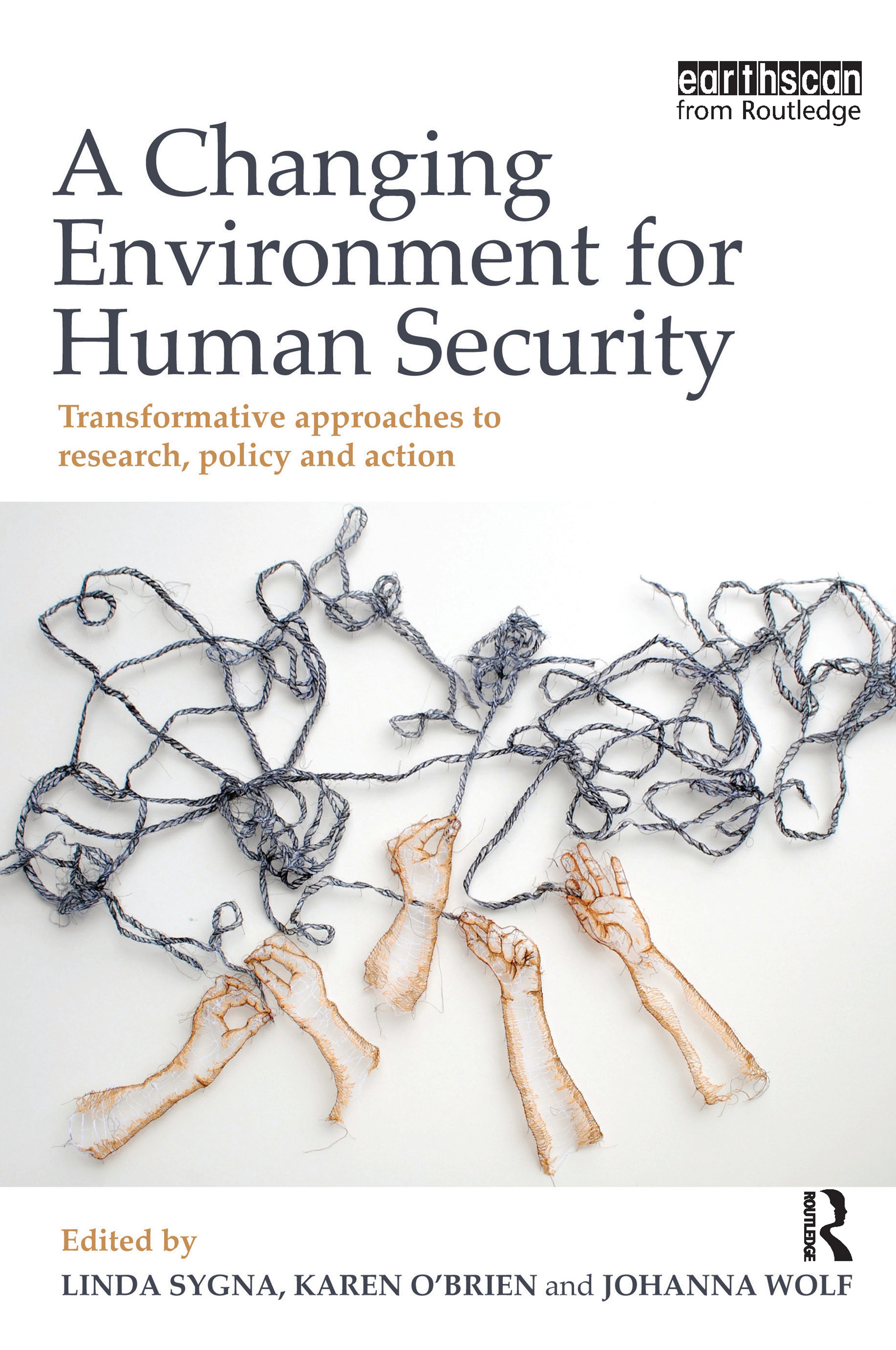
New Books: A Changing Environment for Human Security Transformative Approaches to Research, Policy and Action Edited by Linda Sygna, Karen O'Brien, Johanna Wolf (14 Jun 2013)

A Changing Environment for Human Security

Transformative Approaches to Research, Policy and Action

Edited by Linda Sygna, Karen O'Brien, Johanna Wolf

Descriptions:
Environmental change presents a new context and new opportunities for transformational change. This timely book will inspire new ways of understanding the relationship between environmental change and human security. A Changing Environment for Human Security: Transformative Approaches to Research, Policy and Action both supports and informs a call for new, transformative approaches to research, policy and action. The chapters in this book include critical analyses, case studies and reflections on contemporary environmental and social challenges, with a strong emphasis on those related to climate change. Human thoughts and actions have contributed to an environment of insecurity, manifested as multiple interacting threats that now represent a serious challenge to humanity. Yet humans also have the capacity to collectively transform the economic, political, social and cultural systems and structures that perpetuate human insecurities.
These fresh perspectives on global environmental change from an interdisciplinary group of international experts will inspire readers – whether students, researchers, policy makers, or practitioners – to think differently about environmental issues and sustainability. The contributions show that in a changing environment, human security is not only a possibility, but a choice.

Contents:
Part 1: Reality Check 
Part 2: Breakthrough Conditions
Part 3: Transformations: Past and Future