Showing posts with label WWF. Show all posts

Wednesday, July 17, 2013

HK's Updates: WWF Launches Seafood Guide 2013 (11 Jul 2013)

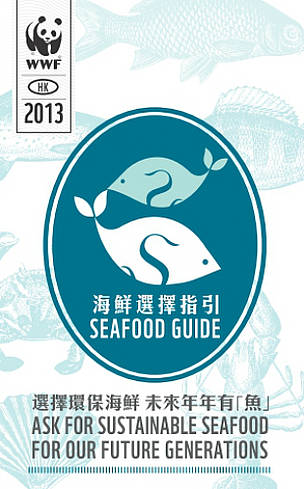
WWF Launches Seafood Guide 2013

Posted 11 July 2013  |  en  |  zh
Hong Kong people are the second largest per-capita consumers of seafood in Asia, with every person consuming an average of 71.6kg of seafood per year. The popularity of seafood in Hong Kong places large demands on both local and overseas fisheries, to the extent that certain species are in danger of being wiped out forever and marine ecosystems around the world are deteriorating. To raise awareness about the need for sustainable seafood consumption, WWF-Hong Kong today announces the results of a sustainable seafood survey and launched an updated version of our popular Seafood Guide.

The survey was conducted between February and May 2013, when WWF visited 48 Chinese restaurants, seafood restaurants and supermarkets to count the number of sustainable and unsustainable seafood species present in these establishments’ water tanks. The survey found that a approxomiately 50% of the species found in these tanks were listed in our Seafood Guide’s “Red – Avoid” category.

Specifically, 51.4% of the seafood found in the Chinese restaurants’ tanks, 50% of the species in the seafood restaurants’ tanks and 38.6% of the seafood in the supermarkets’ tanks came either from unsustainable fisheries, or had been over-exploited, caught or farmed in an ecologically-unfriendly way. A smaller proportion of the seafood surveyed fell into the “Green – Recommended” category: 24.3%, 33.3% and 17.5% in the respective establishments.

The survey also found that some of the species could not be categorized due to insufficient information being provided. This is indicative of a wider problem: generally, there is insufficient data available to the public on which types of seafood are sustainable and which are not; which in turn makes it difficult for the consumer to make the right choices. 

WWF-Hong Kong’s Senior Conservation Officer for Footprint, Dr. Allen To said, “Global studies indicate that in the past 50-100 years we've lost up to 90% of many large predatory fishes, such as some types of tuna, shark and grouper. However, this might only be the tip of the iceberg. Some scientists speculate that if nothing happens to turn the tide, by 2048 the world may run out of important commercial fish species entirely. The world’s oceans will not be able to supply the fishery resources we are so heavily dependent on.”

Adapting to the changes in the world’s seafood resources and to the dining habits of Hong Kong people, WWF has launched an updated version of our Seafood Guide. Compared to the 2007 edition, there has been a rise in the number of “Red – Avoid” seafood species. Some species which were listed as “Yellow – Think Twice” have been moved to the “Red – Avoid” category; one example being the Golden threadfin bream, which has been a very popular species with Chinese diners. More seafood species commonly chosen by Hong Kong people have also been added to the guide.

The 2013 Seafood Guide is indicative of the degradation of the world’s marine ecosystems. WWF hopes that the restaurants and supermarkets will use the guide to facilitate the development of an “Ocean-Friendly Menu”, which provides alternative seafood choices to the dining public, also to provide information on the species, origin and harvesting method so as to faciliate consumer to choose sustainable seafood. Seafood suppliers can also help improve the situation by sourcing and providing more seafood from “Green – Recommended” and “Yellow – Think Twice” categories. It is important that individual diners begin asking restaurants to provide more sustainable seafood.

Representatives from the restaurant and catering sector continue to show their support for WWF; Mr Ng, a seafood restaurant owner, said, “We have always opposed cyanide or fish bomb fishing in Southeast Asia, because it causes huge damage to the marine ecosystem; but some restaurants keep on buying fish from these fishermen. We have to pull the whole industry together to stop the problem.” Frozen seafood supplier Mr Tsui added, “We are glad to see that the sustainable seafood concept is getting more and more popular nowadays, the marine resources problem and sustainable seafood definitely need more promotion and awareness.”


Saturday, July 6, 2013

Indonesian Updates: Illegal palm oil from an Indonesian national park used by Asian Agri, Wilmar, WWF report says By Diana Parker, Mongabay-Indonesia correspondent (5 Jul 2013)

Illegal palm oil from an Indonesian national park used by Asian Agri, Wilmar, WWF report says

By Diana Parker, Mongabay-Indonesia correspondent
July 05, 2013


Illegal palm oil expansion inside Indonesia’s Tesso Nilo National Park is threatening protected forests and the reputation of two companies who claim to be sources of sustainably-produced palm oil, says a new WWF-Indonesia report.

In its June 26 report, “Palming Off a National Park,” WWF-Indonesia found that over 52,000 hectares of natural forests in the area have already been illegally converted into palm oil plantations. And fruits from the illegal plantations have made their way into the supply chains of at least two global companies – Asian Agri and Wilmar.

WWF-Indonesia urged all parties to take immediate action to stop the encroachment, including through implementation of what it called a “win-win solution” – a voluntary relocation program for smallholders already operating illegally inside the park, which was recently proposed by the local government of Pelalawan district and the Ministry of Forestry.

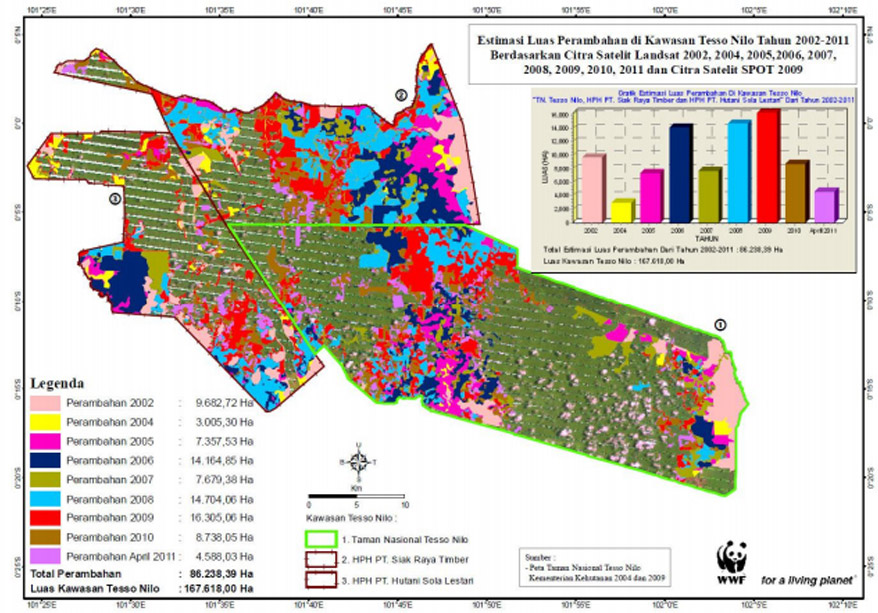
The report documented encroachment inside the Tesso Nilo forest complex, a 167,618-hectare area in Indonesia’s Riau province that includes the national park and two logging concessions – areas zoned for timber exploitation but not for plantation development. Up until 2012, over 52,000 hectares of natural forest in the Tesso Nilo forest complex had already been illegally converted to palm oil plantations, the report found, including over 15,000 ha inside the national park itself.


Tesso Nilo protected area in Sumatra. Map courtesy of Google Earth.


By examining the chain-of-custody of the illegally-produced palm oil fruits – tracking fresh fruit bunches (FFBs) through the supply chain from the smallholder farmers to the processors – WWF found that Asian Agri and Wilmar, both members of the Roundtable on Sustainable Palm Oil (RSPO), had allowed fruits from illegal plantations inside the national park to enter their supply chain. Both companies have since responded to the situation and said they are no longer purchasing fruits from suppliers inside the national park.

“WWF welcomes immediate responses taken by Asian Agri and Wilmar in the area. As dutiful members of RSPO they are obliged to make improvements to tackle this problem,” said Irwan Gunawan, deputy director for WWF-Indonesia’s market transformation initiative.

However, Irwan added, this is not an isolated problem. By looking at just 10 of the 50 mills surrounding the Tesso Nilo forest complex, WWF was able to find evidence that two global companies were using illegally-grown FFBs, indicating that palm oil exported from Indonesia to the global market has likely been contaminated with fruits grown illegally and linked to tropical forest destruction. WWF called on companies to develop more transparent supply chains, track fruits from smallholder plantations to their mills and conduct internal verification to ensure that they are not using fruits from illegal palm oil plantations.

“This problem is not restricted to these companies or the Tesso Nilo area alone,” Irwan said. “Responsible palm oil companies should implement such procedures throughout their whole operations.”


Tesso Nilo forest complex encroachment in Sumatra. Map courtesy of WWF. Click to enlarge.


WWF also encouraged the Indonesian government to immediately take steps to end encroachment in Tesso Nilo. In February 2013, after WWF shared a draft of the report with Indonesia’s Ministry of Forestry, the ministry announced that it would provide financial support to tackle the encroachment problem, including to help voluntarily relocate encroachers to land outside the Tesso Nilo forest complex. The local government of Pelalawan district has also made similar commitments, pledging funds to relocate people residing inside the national park. And while most encroachers in Tesso Nilo are migrants from other provinces, for those smallholders with “adat” or customary rights to the land inside the forest complex, WWF said it will work with these communities to ensure existing plantations are managed sustainably and will advocate for their legal land rights.

Source: http://news.mongabay.com/2013/0705-tesso-nilo-palm-encroachment.html

Sunday, June 30, 2013

Publications: Addressing the encroachment problem in Tesso Nilo National Park by WWF on 26 Jun 2013

Addressing the encroachment problem in Tesso Nilo National Park

The expansion of palm oil plantations into Tesso Nilo National Park needs to be stopped immediately to improve the credibility of Indonesia’s palm oil industry.

Jakarta – Illegal encroachment by palm oil producers poses an immediate threat to Tesso Nilo National Park, according to “Palming Off a National Park” a new report launched by  WWF Indonesia today.  However, the situation could be mitigated through  a win-win solution proposed by the Minister of Forestry and Regent of Pelalawan, Sumatra, which offers  the farmers a voluntary relocation with nearby land provided by the government.
According to the report, up until 2012 over 52,000 hectares of natural forest in Tesso Nilo Forest Complex (made up of a national park and two neighboring logging concessions) has already been converted to palm oil plantations, with over 15,000 ha of the converted area located inside the national park. WWF urges all parties to work on constructive solutions in order to immediately stop further encroachment and help smallholders already illegally in the area to voluntarily relocate. Local government—especially the agency regulating plantation development—is expected to be more active in managing the allocation of palm oil plantation permits. WWF Indonesia is ready to cooperate with all relevant stakeholders—particularly with the indigenous communities of Tesso Nilo—by mapping the location of plantations and assisting plantation management to implement sustainable practices.
The WWF report also shows that up to the end of the first quarter of 2012, two global companies, Asian Agri and Wilmar were not adequately filtered their Fresh Fruit Bunch (FFB) supplies, with some of the fruits sourced from plantations located inside Tesso Nilo National park. As members of the Round Table on Sustainable Palm Oil (RSPO) — under obligation to implement responsible management practices —both companies have since responded to the situation and ceased sourcing from suppliers located inside the park.
Irwan Gunawan, Deputy Director of WWF-Indonesia’s Market Transformation Initiative recognizes efforts made by the companies. “WWF welcomes immediate responses taken by Asian Agri and Wilmar in the area. As dutiful members of RSPO they are obliged to make improvements to tackle this problem.” WWF calls for both companies to develop and implement a robust and transparent chain of custody, tracking the FFB from smallholder plantations to their mills, as well as conducting internal verification to identify and stop any endorsement for illegal palm oil plantations.  
“This problem is not restricted to these companies or the Tesso Nilo area alone.  Responsible palm oil companies should implement such procedures throughout their whole operations.”
“Buyers of palm oil products should be rewarding the industry that ensures they source palm oil legally and from non-HCV (High Conservation Value) areas,” said Nazir Foead, WWF-Indonesia Conservation Director. “It is very crucial for Indonesia, as the largest palm oil exporting country in the world, to cultivate credible systems for sustainable palm oil production.” 
“WWF encourages the local authorities and the park management to verify land ownerships in order to  immediately develop viable solutions such as the relocation mechanism proposed by the government.”


For more info, please kindly contact:
Irwan Gunawan, Deputy Director Market Transformation Initiative, WWF-Indonesia
Email: igunawan@wwf.or.id, Mobile: +62 812 8748 535

Annisa Ruzuar, Communication Coordinator Market Transformation Initiative, WWF- Indonesia
Email: asruzuar@wwf.or.id, Mobile: +62 813 2004 4343

Desmarita Murni, Head of Communication and Campaign, WWF-Indonesia
Email: dmurni@wwf.or.id, Mobile: +62 811 793 458


Notes for Editors:
  • The investigation report titled ”Palming off Tesso Nilo National Park”, can be accessed throughhttp://awsassets.panda.org/downloads/wwf_indonesia__25jun13__palming_off_a_national_park_final__2_.pd
  • Tesso Nilo forest complex comprises of Tesso Nilo National Park, PT Hutani Sola Lestari and PT Siak Timber Raya logging concessions.
  • Analysis from Landsat Satellite Images 2002 – on April 2011 shows an increase in encroachment areas inside the 167,618 hectare Tesso Nilo forest complex each year with peaks in 2006 with newly recorded encroachment area of 14,165 hectares, in 2008 with 14,704 ha, and the highest in 2009 with 16,305 ha. The worst encroached area in the Tesso Nilo forest complex is PT Siak Raya Timber logging concession with 84% of the concession area or 32,310 ha encroached, followed by Tesso Nilo National Park, reaching 43% or 35,416 ha. Encroachment in PT Hutani Sola Lestari logging concession reached 40% or 18,497 ha. 
  • Oil palm plantations inside the Tesso Nilo forest complex are controlled and managed by individual owners or groups. The identification showed that 524 individuals dominate 72% (26,298 ha) of the total plantation areas (36,353 ha). Average plantation size per individual was 50 hectares, far above the typical size for a smallholder, suggesting availability of significant capital. The WWF investigation also identified 17 encroacher groups to have oil palm plantations in the Tesso Nilo forest complex. 


For more information:

Monday, June 10, 2013

Indonesian Updates: More Than 100 Elephants Died in Riau Since 2004: WWF (4 Jun 2013)

WWFMore Than 100 Elephants Died in Riau Since 2004: WWF

Posted on 04 June 2013 

Riau, Sumatra, June 4, 2013. WWF-Indonesia database shows that more than 100 sumatran elephants (Elephas maximus sumatranus) died in Riau, Province of Sumatra, since 2004. Meanwhile 15 elephants found dead in 2012 only.
 
This number keeps escalating. On May 31, 2013, WWF-Indonesia GPS collar installation team found two more elephants dead in Tesso Nilo area; a carcass of an adult male elephant was found in Riau Andalan Pulp and Paper (RAPP) concession area Ukui Sector which is overlapped with Tesso Nilo National Park area and the other wasa carcass of an adult female elephant found inside the boudary of Tesso Nilo National Park. The team estimated that they have died for three or four days before being found and suspected unnatural death was due to poisoning. 
 
Previously, on May 6, 2013, WWF-Indonesia monitoring team found a carcass of male elephant without tusks in RAPP concession Baserah Sector, Tesso Nilo area. A detergent plastic packaging was found inside its intestine which suspected contained poison. 
 
Although related institutions, including Natural Resource Conservation Agency of Riau Province and Pelalawan Region Farming Office, had deployed autopsy team to follow up WWF report on elephant deaths, real action is still yet to be conducted towards these incidents beyond just  securing tusks of the male elephant found in Ukui Sector. 
 
"Every finding of unnatural death of protected animal should be responded immediately action by the authority such as thorough investigations and when applicable prosecution. The unnatural death of every individual of key species like Sumatran elephant should be consideredas the loss of state’s assets, especially the Sumatran elephantthat is already in its critical condition due to human pressures and neglect,” said Sunarto, Species Expert of WWF-Indonesia. 
 
WWF-Indonesia urges Ministry of Forestry to enforce the law on elephant deaths in Riau as stated by Minister of Forestry, Zulkifli Hasan, several times, including during his visit to Tesso Nilo National Park on February 8, 2013. The Minister even stated to publish a competition and to give award for those who report on elephant killer. 
 
“The massiveamount of elephant deaths indicatesthat the government has not handle these cases seriously. Real actions are needed in the field in order to give detterent effect and to prevent elephant death in the future,” said Anwar Purwoto, Director of Forest, Freshwater and Terrestrial Species of WWF-Indonesia. 
 
In Sumatra, elephant condition is devastating. No less than 29 elephants died in Riau, Aceh and Lampung provinces in 2012. In Aceh alone, 14 elephant deaths were recorded in regions of Aceh Jaya, South Aceh, West Aceh, East Aceh, North Aceh and Bireuen. WWF-Indonesia recent study shows that in the last 25 years, sumatran elephants have lost 70% of their habitats as well as declining population for more than a half. Sumatran elephant population estimation in 2007 was 2400-2800 individuals. 
 
 
For further information, please contact:

Sunarto, WWF-Indonesia Elephant and Tiger Conservation Coordinator,
Email: sunarto@wwf.or.id, mobile: +628119950521.

Syamsidar, Communication Officer WWF Riau,
Email: syamsidar@wwf.or.id, mobile: +628126896095.
 
Diah Sulistiowati, Communication Coordinator FFS Program WWF-Indonesia,
Email: dsulistiowati@wwf.or.id, mobile: +628111004397.
 
 
Note for Editor: 
Related photos and maps may be downloaded via this link below by including copyright @WWF-Indonesia
 

About WWF-Indonesia
WWF-Indonesia is the largest natural conservation organization in Indonesia. It started its activity since 1962 and become an Indonesian foundation since 1998. Currently, WWF-Indonesia works in 28 regional offices with 400 staffs througout Indonesia. Since 2006, WWF-Indonesia has been supported by 54 thousands supporters from all over Indonesia. For further information, please visit www.wwf.or.id.

Source: 

Saturday, March 9, 2013

Events: Earth Hour 2013 organized by WWF on 23 Mar 2013


Earth Hour 2013


EARTH HOUR 2013

Earth Hour 2013 will be on 8:30pm, Saturday 23 March 2013
 / ©: WWF-Hong Kong
© WWF-Hong Kong
Since its creation, Earth Hour has given people everywhere a chance to collaborate and take action in a global-scale event, and a chance to have their concerns about climate change voiced to the world.

In addressing the threat of climate change and helping to reduce Hong Kong’s ecological footprint, an important part of WWF’s work in Hong Kong involves helping people understand how simple everyday actions reduce our carbon footprint and impact the world’s resources.
Earth Hour 2009 kids' flag / ©: WWF-Hong Kong
© WWF-Hong Kong
2009 marked Hong Kong's first major participation in Earth Hour. Led by WWF-Hong Kong, the city's involvement in Earth Hour spreads a powerful message that as one of Asia's leading cities, Hong Kong cares about climate change. We can act together to make a difference through a simple action that anyone can participate in.

The enthusiasm for Earth Hour in Hong Kong's community and media at large reached levels never before seen.
 / ©: Ringo Ma / WWF-Hong Kong
© WWF-Hong Kong
2.9 million people of Hong Kong participated in Earth Hour, joining the global voice from around the world. A survey conducted after Earth Hour showed that 99 percent of all participants wanted to take action in their daily lives to save energy and reduce their impact on the environment.

In addition, the victoria habour went dark in that hour, over 1,800 of Hong Kong’s major buildings and landmarks switched off their lights for Earth Hour, including the International Financial Centre, the Cultural Centre Complex and the Tsing Ma Bridge. More than 600 companies, organizations and over 160 schools and all universities joined millions of individuals in support of WWF-Hong Kong’s call for action on climate change.

With over 4,000 cities from 88 countries participating in Earth Hour, the campaign sent a strong message to world leaders attending the Copenhagen UN climate summit in December 2009, urging them to agree on a new global climate deal aimed at protecting the future of our planet.

WWF invites every Hong Kong individual to live every day like it’s Earth Hour day. Adopt a low-carbon lifestyle and be part of the solution in tackling climate change.
For more information:

Sunday, December 2, 2012

Events: WWF - Hong Kong: The Big Bird Race 2013 (2 Feb 2013)

The Big Bird Race 2013


Organized by WWF- Hong Kong

Date: 2 February 2013 (Saturday)

Time: 6:30 a.m. to 6:30 p.m


Introduction

 / ©: So Wai Li

 / ©: WWF-Hong Kong
© WWF-Hong Kong
The Big Bird Race 2013 will be held on 2 February 2013 (Saturday) - International Wetlands Day, from 6:30 a.m. to 6:30 p.m.

Each team will be made up of four members who must participate in the entire Race: no replacements of individuals can be made during the race period. An additional non-bird watching driver and recorder are permitted to accompany each team. Teams will aim to record as many birds as they see – anywhere in Hong Kong – within the 12-hour period. Teams may start anywhere they choose, but must finish in the car park of Mai Po Nature Reserve.

Only species listed in either Categories A to D of The Avifauna of Hong Kong, (Carey et al. 2001), the Big Bird Race 2013 logbook, or those accepted by the Adjudicator will form part of the count, subject to the following:
  1. Birds must be unrestrained.
  2. Oiled or sick birds will not be counted.
  3. Species which have obviously been released from captivity within a few days of the Race will not be counted.
  4. All species must be recorded within the territory of Hong Kong SAR.
  5. Only species positively identified are acceptable.
  6. Attracting birds with tape-recorders or any digital audio equipment is prohibited.
The details of team enrolment will be provided in due course. Please visit our website for the latest updates.

Award
To encourage participation and support, a number of awards and exciting prizes will be presented to participating teams, including:
  • Most Birds Seen
  • Bird of the Day
  • Most Wetland Birds Seen
  • Dip of the Day
  • Fundraising Awards


Why Support Big Bird Race?

  • To raise funds to help maintain Mai Po as an internationally important wetland;
  • To discover the amazing diversity of bird species in Hong Kong;
  • To learn from professional bird watchers;
  • To appreciate the natural beauty of Mai Po and Deep Bay and have fun while doing so;
  • To raise your company’s corporate profile and brand exposure by becoming a sponsor.
For more details about corporate sponsorship, please contact Mr. Marius Chow at  2864 1410 or Ms. Cammie Ma at  2864 1462 or emailevents@wwf.org.hk for more information.

Thursday, November 15, 2012

Chinese Updates: China Surveys Endangered Porpoises

China Surveys Endangered Porpoises
2012-11-13


Chinese scientists on Sunday launched a survey of endangered finless porpoises in the country's largest river Yangtze, amid worries that the freshwater mammal might be on the verge of extinction.

Consisting of researchers from the Ministry of Agriculture, the Chinese Academy of Sciences (CAS) and the World Wide Fund for Nature (WWF), the survey team set off in Wuhan, a central Chinese city along the Yangtze River.

The 40-day survey is the most comprehensive since 2006, when a survey found the population of finless porpoises down to 1,800 and pronounced the white-flag dolphin, a larger mammal native to the river, close to extinction.

There are probably only 1,000 finless porpoises in the Yangtze and two lakes linked to the waterway after continuous drops in the number, said Wang Ding, researcher from the Institute of Hydrobiology under the CAS.

"Finless porpoises may die out within 10 to 15 years, if strong measures are not taken," Wang warned.

The survey team will trace the porpoises using sonar system along the middle and lower reaches of the river, collecting data on the species' population, which will assist in the making of future protection policies.

The initial results of the survey will be published in December.

"As the flagship species in the Yangtze, finless porpoises are the barometer of the river's ecological conditions," said Wang Kexiong, deputy commander of the survey team.

"NOT OPTIMISTIC"

Scientists said the survey may not produce optimistic results, as human activities including illegal fishing, sand dredging and pollution have pushed the species to the brink of extinction.

In 2006, a similar survey found no white-flag dolphins along the Yangtze River, suggesting them as being "functionally extinct," which means the population is too small for the species' reproduction.

Both mammals were regarded as the symbol of the river, with groups of them seen swimming around ships, a demonstration of better river ecology back then.

Chinese scientists on Sunday launched a survey of endangered finless porpoises in the country's largest river Yangtze, amid worries that the freshwater mammal might be on the verge of extinction.

Consisting of researchers from the Ministry of Agriculture, the Chinese Academy of Sciences (CAS) and the World Wide Fund for Nature (WWF), the survey team set off in Wuhan, a central Chinese city along the Yangtze River.

The 40-day survey is the most comprehensive since 2006, when a survey found the population of finless porpoises down to 1,800 and pronounced the white-flag dolphin, a larger mammal native to the river, close to extinction.

There are probably only 1,000 finless porpoises in the Yangtze and two lakes linked to the waterway after continuous drops in the number, said Wang Ding, researcher from the Institute of Hydrobiology under the CAS.

"Finless porpoises may die out within 10 to 15 years, if strong measures are not taken," Wang warned.

The survey team will trace the porpoises using sonar system along the middle and lower reaches of the river, collecting data on the species' population, which will assist in the making of future protection policies.

The initial results of the survey will be published in December.

"As the flagship species in the Yangtze, finless porpoises are the barometer of the river's ecological conditions," said Wang Kexiong, deputy commander of the survey team.

"NOT OPTIMISTIC"

Scientists said the survey may not produce optimistic results, as human activities including illegal fishing, sand dredging and pollution have pushed the species to the brink of extinction.

In 2006, a similar survey found no white-flag dolphins along the Yangtze River, suggesting them as being "functionally extinct," which means the population is too small for the species' reproduction.

Both mammals were regarded as the symbol of the river, with groups of them seen swimming around ships, a demonstration of better river ecology back then.

Source:Xinhua
 
More information from: