Showing posts with label food. Show all posts

Thursday, August 1, 2013

Events: First International Conference on Global Food Security 29 Sep - 2 Oct 2013


Event


First International Conference on Global Food Security


The First International Conference on Global Food Security aims to explore the economic, social, biophysical, technological and institutional drivers of current and future global food security. The topics list includes, inter alia: enabling trade and market policies for local and global food security; sustainable intensification of food production systems; novel ways of feeding 9 billion; land sparing, land sharing and trade-offs; agricultural production as feedstock for renewables; lost harvest and wasted food; nutritional security; and labelling, certifying and striving for quality and sustainability of food production. 


dates: 29 September - 2 October 2013   
location: Noordwijk, Netherlands   

Sunday, June 30, 2013

Publications: FAO Statistical Yearbook Highlights Food Production’s GHG Emissions (19 Jun 2013)


News


FAO Statistical Yearbook Highlights Food Production’s GHG Emissions


FAO19 June 2013: The Food and Agriculture Organization of the UN (FAO) has released its Statistical Yearbook for 2013, which provides a lens into agriculture's contribution to climate change, natural resource management, and food security.

The Yearbook covers the following topics: capital and investment; climate change; food availability; food production and trade; food prices; hunger and malnutrition; the consequences of political instability and natural- and human-induced disasters on food security; the state of the agricultural resource base and sustainability; and environmental impacts.

It notes that greenhouse gas (GHG) emissions from the agriculture sector have grown 1.6% per year since 2000, equivalent to 10% of anthropogenic emissions. It indicates that livestock and fertilizer are the two greatest contributors to emissions in the sector.

The Yearbook also highlights that 12% of the global population was undernourished in 2010-2012, and that global crop production has tripled over the past 50 years. It further underscores the increase in agricultural research and development investments. [Publication: FAO Statistical Yearbook 2013] [FAO Press Release]


For more information: 

Research: Growth in crop yields inadequate to feed the world by 2050 (20 Jun 2013)

Growth in crop yields inadequate to feed the world by 2050 – research

Agriculture productivity not rising fast enough to meet the needs of a rapidly growing population
Thursday 20 June 2013 17.21 BST guardian.co.uk,
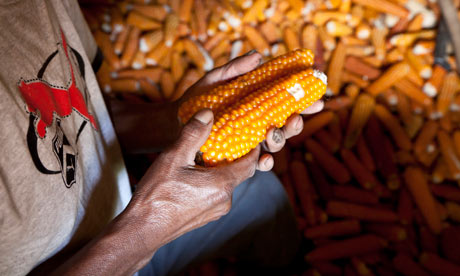
Maize : Close up of the hands of a male Mayan, Guatemalan farmer holding corn or maizeIf the world is to grow enough food for the projected global population in 2050, agricultural productivity will have to rise by at least 60%, and may need to more than double, according to researchers who have studied global crop yields.
They say that productivity is not rising fast enough at present to meet the likely demands on agriculture.
The researchers studied yields of four key staple crops – maize, rice, wheat and soybeans – and found they were increasing by only about 0.9% to 1.6% a year. That would lead to an overall increase of about 38% to 67% by 2050, which would only be enough to feed the population if the lower end of the estimate of yields needed and the maximum yield increase turns out to be the case.
It also does not take into account other factors, such as climate change, which the World Bank said this week could lead to massive food shortages in many areas as soon as the 2030s.
The study's findings are also likely to fuel debate over the efficacy of genetically modified crops, which some scientists have argued may be needed in future to feed the rapidly growing global population, which is expected to reach at least 9 billion by 2050.
Deepak Ray, who led the new research, said that some countries were faring far worse than others. For instance, in Guatemala, the productivity of the maize agriculture is declining, while the population is growing.
The slow increase in agricultural productivity around the world stands in marked contrast to the "green revolution" that led to a huge increase in crop yields in Asia in the 1960s to 1970s, with the widespread use of new artificial fertilisers, pesticides and growing techniques. The green revolution enabled high population growth and sparked unprecedented economic growth in many Asian countries. Signs that its effects have petered out could be a warning that future population growth may be harder to accommodate.
There is also a danger that large swathes of pristine land — including forests — could be cleared for agriculture to compensate for the slow growth in yields, with potentially damaging effects on the climate and on ecosystems. Fertile agricultural land is at a premium in most countries, and overuse, water scarcity and soil degradation are taking further tolls.
However, the authors of the study only examined crop yields — they emphasised that there should be other ways to improve the world's food supply, including increasing efficiency and cutting the massive waste of food that takes place in both developed and developing countries.
Jon Foley, co-author of the paper, said: "Clearly, the world faces a looming agricultural crisis, with yield increases insufficient to keep up with projected demands. The good news is, opportunities exist to increase production through more efficient use of current arable lands and increased yield growth rates by spreading best management practices. If we are to boost production in these key crops to meet projected needs, we have no time to waste."

Saturday, June 29, 2013

Publications: Creating a Sustainable Food Future, Installment Two: Reducing Food Loss and Waste by Brian Lipinski, Craig Hanson, Richard Waite, Tim Searchinger, James Lomax, Lisa Kitinoja (Jun 2013)

Creating a Sustainable Food Future, Installment Two: Reducing Food Loss and Waste

Brian LipinskiCraig HansonRichard WaiteTim Searchinger, James Lomax, Lisa Kitinoja
Working Paper: June, 2013

About 24 percent of all calories currently produced for human consumption are lost or wasted. This paper examines the implications of this amount of loss and waste, profiles a number of approaches for reducing it, and puts forth five recommendations for how to move forward on this issue. “Reducing Food Loss and Waste” is the second installment in the series that forms the foundation of the “World Resources Report 2013-14: Creating a Sustainable Food Future.”
WRI working papers contain preliminary research, analysis, findings, and recommendations. They are circulated to stimulate timely discussion and critical feedback and to influence ongoing debate on emerging issues. Most working papers are eventually published in another form and their content may be revised.

Inquiries


Downloads

Full Text (PDF, 1.1 Mb)
Licensed under Creative Commons (more info).

Summary 
The Food and Agriculture Organization of the United Nations (FAO) estimates that 32 percent of all food produced in the world was lost or wasted in 2009. This estimate is based on weight. When converted into calories, global food loss and waste amounts to approximately 24 percent of all food produced. Essentially, one out of every four food calories intended for people is not ultimately consumed by them.
Food loss and waste have many negative economic and environmental impacts. Economically, they represent a wasted investment that can reduce farmers’ incomes and increase consumers’ expenses. Environmentally, food loss and waste inflict a host of impacts, including unnecessary greenhouse gas emissions and inefficiently used water and land, which in turn can lead to diminished natural ecosystems and the services they provide.
Big inefficiencies suggest big savings opportunities. We estimate that if the current rate of food loss and waste were cut in half―from 24 percent to 12 percent―by the year 2050, the world would need about 1,314 trillion kilocalories (kcal) less food per year than it would in the business-as-usual global food requirements scenario described in The Great Balancing Act, the first installment of this World Resources Report working paper series. That savings–1,314 trillion kcal–is roughly 22 percent of the 6,000 trillion kcal per year gap between food available today and that needed in 2050. Thus, reducing food loss and waste could be one of the leading global strategies for achieving a sustainable food future.
In this paper, we profile a subset of approaches to reducing food loss and waste that experts suggest are particularly practical and cost-effective, that could be implemented relatively quickly, and that could achieve quick gains. We also recommend a number of cross-cutting strategies to further galvanize commitment to reducing food loss and waste.
Reducing Food Loss and Waste is the second in a series of working papers that we’ll roll out over the course of a year. Each subsequent paper will take a detailed look at a potential solution that could help achieve a sustainable food future. These installments will set the foundation for and culminate in the World Resources Report 2013-2014: Creating a Sustainable Food Future. To learn more about the series and sign up to receive updates, visit the World Resources Report website.