Showing posts with label rivers. Show all posts

Saturday, July 6, 2013

Vietnamese Updates: The future of the Mekong Delta: Challenges and orientation for development (22 Jun 2013)

The future of the Mekong Delta: Challenges and orientation for development
Thứ bẩy, ngày 22 tháng 06 năm 2013 cập nhật lúc 03:23

Mekong Delta, which had been once considered as a symbol of prosperity. With an area of nearly 40,000 km2 and a population of 17 million people, of which nearly three quarters are farmers, this land is the large granary of the country. However, the challenges of climate change and the impact of the economic downturn has forced MekongDelta to face the threat of food and people security.
Facing the challenge


The granary in Mekong Delta

In 2012, Mekong Delta (MD) produced more than 25 million tons of rice and exported about 7 million tons of rice; however, it does not reinforce the nine-dragon land. The reason is that, during the length of development time, according to the statement of Mr. Phan Thanh Binh, Director of National University of Ho Chi Minh City on the Delta International Dialogue om 2013 held in Ho Chi Minh City: The contribution of agriculture in the Mekong Delta's entire GDP decreased from 42% in 2005 to 30% in 2010. Per capita income decreased from 115% compared to the national average in 1999 to 85% in 2010.

In these difficult conditions, the uncertain elements due to the impact of climate change and human activities in headwater area have the potential to profoundly affect the future of Mekong Delta. The impact of socio-economic development in the area of headwater basin would alter the water resources of the area towards the disadvantage direction that can hardly be predicted or controlled. A series of hydroelectric and agricultural reservoirs forming in the headwater area of MekongRiver in the future would make it difficult to control water shortages in dry season and floods in rainy season.

In Vietnam, the Mekong River basin covers about 71,000 km2, accounting for over 8% of the entire basin. Mekong Delta area covers 12% of the total country area, including 13 cities and provinces. Annually, Mekong Delta contributes up to 27% of GDP with 90% of exported rice and nearly 60% of exported seafood of Vietnam. However, this region is currently facing enormous challenges related to water issues, the status of salinity and other impacts of climate change. It has become one of the five major river basins with the most degrading river channels due to droughts. Currently, the salt water has arrived in the area of ​​Tan Chau and Chau Doc in An Giang provinces, which has never occurred in the past. By 2100, sea level could rise by 1 meter, causing the loss of 40% of the Mekong Delta. These challenges have serious impacts on the ecosystem, agricultural & fisheries activities and the lives of millions of people in the area as well as the issue of ensuring food security in Vietnam and concerned countries.

According to a report released by WWF last month, six countries in the Greater Mekong Sub-region (GMS) including CambodiaChina(Yunnan province and Zhuang autonomous region of Guangxi), LaosMyanmarThailand and Vietnam are facing serious threats to the key natural resources. These threats consist of the threat of losing more than a third of the remaining cover forest area within the next two decades and the collapsed ability of Mekong's ecosystem.

Orientation towards green growth
To actively respond to climate change with a series of related challenges, Vietnam’s Government has issued the sustainable development strategy in the period of 2011 - 2020, National Strategy on Water Resources in 2020 and more specific action programs, simultaneously promote the efficient use and sustainable management of water resources, including water supply in Delta regions. To preserve and protect the ecosystem in the Mekong River Basin is the way to keep alive the rich and diversified living resources for people of the nine-dragon land.

Mr. Javed Mir, Head of Natural Resources and Environment Committee under the Southeast Asia Department of Asian Development Bank (ADB) said that, a developing future with low low carbon emission and equality in term of society is an essential element to protect the natural resources of the sub-region, thus ensuring economic growth in the long term. It may lead to a reconsideration of the decision-making system and investment policies in the region as well as  the efficient relationship construction between public and personal partners to efficiently reinforce the economic welfare of people . For sustainable development of Mekong Delta and prevent this area from collapsing threat, it is necessary to follow green development, environmental protection and natural respect.


T.Minh


Wednesday, June 26, 2013

Vietnamese Updates: Efforts to save Dong Nai River (20 Jun 2013)


Heavilly-polluted Dong Nai river

Efforts to save Dong Nai River 

Thứ năm, ngày 20 tháng 06 năm 2013 cập nhật lúc 04:09

Environmental basin of the Dong Nai river system has a special importance forsustainable development in 11 provinces, including Ho Chi Minh CityDongNaiBinh DuongBinh PhuocBa Ria - Vung TauLam Dong , Dak LakNinhThuanBinh ThuanTay NinhLong AnThe Dong Nai river system supplieswater for living and agricultural and industrial productionAt the same time,Dong Nai river system receives agriculturalindustrial and hospital waste waters and part of solid urban wasteHowever, the water pollution in the riverbasin is increasing at an alarming rateTherefore, the environment protection in the Dong Nai River is an urgent problem nowadays.

The latest data monitored by the Center of Dong Nai Environment Engineering andMonitoring in more than 100 sites in riversstreams and lakes in the province ofDong Nai has showed that in many places, water is heavily contaminated. It isestimated that urban areas and businesses along the basin of Dong Nai river systemrelease approximately 5 million m3 of waste water  per day with a total of 600,000kgBOD1.1 million kg COD200.000kg nitrogen, and 760,000kg SS. Therefore, DongNai river’s water quality can not meet standards of water supply for daily life. Especially, the Thi Vai river’s water sources do not meetstandards for aquaculture production.

To minimize pollution on Dong Nai Riverin 2003the former Minister of Natural Resources and Environment Mai Ai Truc met leaders of 11 provinces to make immediate measures to restore Dong Nai River’s environmentMany solutions to improve water quality in the river havebeen carried outThe Prime Minister has signed Decision N. 187 on environmental protection of Dong Nai river system to 2020. According to this Decision, the provinces in the river basin to the year 2010 have improved effectively environment quality and water quality of the Dong Nai river systemSpecifically80of industrial zone, export processing zones collected 90of domestic waste90of industrial solid waste70% of hazardous waste and 100of medical wasteTo achieve this goalthe total cost will be 2,000 trillion. Currently, the Ministry of Natural Resources and Environment is also trying to protect the basin of the Dong Nai river system by submitting to theGovernment a draft decree promulgating the list of prohibited and restricted investment areas on river basinsAt the same timethe Ministry proposed to find the measures to improve the human resources and management mechanisms.

In addition to the above policies, according to Deputy Minister of Natural Resources and Environment Bui Cach Tuyen, provinces and cities in the basin in the basin should urgently build implementation plan and allocate adequate funds to accelerate construction of treatment facilities of wastewater, solid waste in urban areas, industrial zones and industrial clusters. In particular, it is urgently to unify coordination mechanism among provinces and cities in the basin, avoiding the conflicts in the basin. To do this, the Dong Nai river system would be escaped from pollution.

Mai Chi

Source: 

Monday, June 10, 2013

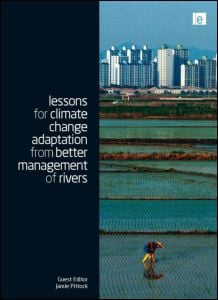
New Books: Lessons for Climate Change Adaptation from Better Management of Rivers Edited by Jamie Pittock (1 Jun 2013)

Lessons for Climate Change Adaptation from Better Management of Rivers

Edited by Jamie Pittock

Published 1st June 2013 by Routledge – 96 pages
Descriptions:
Climate change is dramatically affecting freshwater supplies, particularly in the developing world. The papers in this volume present a powerful case for and exploration of different freshwater adaptation strategies in the face of global climatic change. The volume centres on six detailed case studies, from India, China, Mexico, Brazil, the lower Danube basin and Tanzania, written by experienced local academics and practitioners. They assess autonomous adaptation in the freshwater sector, drawing out key lessons about what motivated these societies to change, which factors led to more successful adaptation, and how interventions may best be sustained. The volume also contains a global overview of the lessons derived from these experiences. It sheds light on two key theories: that vulnerability to climate change is best reduced by reducing poverty and promoting sustainable development first, or by reducing bio-physical risks from climate change. The publication also highlights the need to ensure that access to more precise climate change impact data is not used as an excuse to delay implementation of no regrets adaptation measures.

Contents:
1. Water and Climate Change Adaptation
2. Lessons for Climate Change from Better Management of Rivers
3. Floodplain Restoration Along the Lower Danube: A Climate Change Adaptation Case Study
4. Freshwater Management and Climate Change Adaptation: Experiences from the Great Ruaha River Catchment in Tanzania
5. Restoration of Traditional Water Storage Systems: An Effective Strategy to Meet the Water Demand and Adopt to the Uncertainties of Climate Change while Improving the Livelihoods and Ecosystems - a Case Study of Maner Sub-Basin, Godavari River, India
6. Freshwater Management and Climate Change Adaptation - Experiences from the Central Yangtze Region in China
7. Integrated River Basin Management in the Conchos River Basin, Mexico: A Freshwater Climate Change Adaptation Study
8. The Basis for Climate Change Adaptation Under a Successful Participatory Process, Sao Joao Basin, Brazil
9. Embracing Uncertainty in Freshwater Climate Change Adaptation: A Natural History Approach