Thursday, August 16, 2012

Call for Papers: Roundtable Workshop on Cleantech and India’s Vision, 7 September 2012, India


Roundtable Workshop on Cleantech and India’s Vision 


International Round-table Workshop on Clean Technology and India's Vision by Jagurih Group & Waterloo Global Science Initiative (WGSI) [6 days left]
7th September 2012
New Delhi, Delhi, India

International Round-table workshop on "Clean-technology and India's Vision" . The major themes of the workshop are Solar energy, Energy Efficiency, Building Efficiency,Biomass and Waste Management .

Organized by: Jagurih Group and Waterloo Global Science Initiative
Deadline for abstracts/proposals: 22nd August 2012

Website: http://jagurihgroup.files.wordpress.com/2012/08/august08-poster-cleantech-workshop-final.pdf

Fifth International Conference of the Latin American Studies Council of Asia and Oceania (CELAO) 2012, October 9-11 2012, Philippines


Fifth International Conference of the Latin American Studies Council of Asia and Oceania (CELAO) 2012


"Strengthening Exchanges across the Pacific"


October 9-11, 2012


Manila, Philippines


download CONFERENCE PROGRAM here


This conference is jointly organized by the Latin American Studies Council of Asia and Oceania (Consejo de Estudios Lati noamericanos de Asia y de Oceanía - CELAO) and the Philippine Academic Consortium for Latin American Studies (PACLAS).

CELAO was established in Osaka, Japan in 2003 to serve as a forum for multidisciplinary research on Latin America and to promote cooperation with similar organizations devoted to Latin American studies. Its current president is Dr. Enrique Valencia Lomeli from the University of Guadalajara in Mexico. The first conference was held at La Trobe University in Melbourne, Australia on July 14th -16th, 2005; the second in Seoul, Korea on June 21-23 2007; and the third at Jawaharlal Nehru University, New Delhi, India on December 3-5, 2008. The fourth and most recent conference was held at the University of Guadalajara, Mexico on November 22-24, 2010.

CELAO's fifth international conference is at the same time the third of PACLAS. The Philippine consortium was established in 2002 under the auspices of the Department of Foreign Affairs of the Philippines, as an offshoot of the Forum for East Asia-latin America Cooperation (FEALAC). Its members are Ateneo de Manila University, De La Salle University-Dasmariñas, Department of Foreign Affairs, Foreign Service Institute, Philippine Institute for Development Studies (Secretariat), University of Asia and the Pacific (Chair), University of the East (Deputy chair), University of the Philippines, University of Santo Tomas. The twofold aim of PACLAS is to promote Latin American studies in the Philippines and to contribute to the revitalization of Philippine relations with Latin America; it is an aim that counts on shared heritage. As flagship project, the first international conference in 2008 was held at the University of the City of Manila and University of the Philippines-Diliman in 2008, and the second at De La Salle University-Manila and University of Santo Tomas in 2010.

CALL FOR PAPERS:


The theme for CELAO 2012, "Strengthening Exchanges across the Pacific" has as its overarching object the rich potential and actual cooperation among the countries of Asia and Latin America. It seeks to explore the multiple dimensions of interaction in time and space particularly in what has evolved into the Asia-Pacific region. Exchange involves people, ideas, goods and values; shared experiences and heritage; converging issues and solutions even in divergent contexts. It presents a rich field for comparative studies between different countries and between sub-regions.


The papers should address any of the following sub-themes:

    1. Movements of people (including labor migration) and transnational identities

    2.Trade relations and policy'; transpacific investments

    3.Maritime industry (shipping, seafarers, ports)

    4. Diplomacy, security and conflict resolution

    5. South-South exchange

    6. Democratic transition, retrogression and consolidation

    7. Civil society and civil action

    8. Labor relations; social welfare programs

    9. Culture and heritage: the arts, language and literature, history

    10. Religion, gender and society

    11. Environmental issues and urban development; tourism

    12. Transfer of technology

Website: http://www.paclas.org.ph/

Chinese Updates: China's First CCS Project Captures 40,000 Tonnes of CO2


China's First CCS Project Captures 40,000 Tonnes of CO2
2012-08-07

China's first carbon capture and storage (CCS) demonstration project sealed off more than 40,000 tonnes of carbon dioxide in the past 15 months in north China's Inner Mongolia autonomous region, operators told Xinhua Monday.

As an environmental protection project of China's megaton direct liquefaction coal project, the CCS project was listed as a national key technology project and was implemented by China's leading coal company Shenhua Group Corporation Ltd, located in Wulanmulun, Erjinhoro Banner, Inner Mongolia.
The project proved China as the first country able to realize the entire process of capturing carbon dioxide and sealing it in saline aquifers, said Shu Geping, general engineer of China Shenhua Coal to Liquid and Chemical Co., Ltd.

Experiments and research are still underway and the goal of sealing 300,000 tonnes of carbon dioxide is expected to be realized in June 2014, Shu said.

The underground saline aquifers in Ordos Basin in Inner Mongolia can store tens of billions of carbon dioxide, and this kind of basin is quite common in China, which means the demonstration project will greatly contribute to reducing China's carbon emissions, said Zhang Dongxiao, dean of the Clean Energy Research Institute of Peking University.

About 80 percent of China's carbon dioxide emissions come from coal burning. China made a promise to the United Nations that by 2020 the country would reduce carbon dioxide emissions per gross domestic product by 40 to 45 percent, based on levels observed in 2005.

Researchers with Shenhua said the current CCS technology only stores carbon dioxide but can not generate profits. To popularize the technology, carbon dioxide needs to become a resource that can be utilized, and Shenhua has started relevant research, Shu said.

Source: http://english.mep.gov.cn/News_service/media_news/201208/t20120807_234453.htm

Monday, August 13, 2012

New Book: Doing Environmental Ethics by Robert Traer

Doing Environmental Ethics

2nd Edition
July 2012
Trade Paperback · 400 Pages
$40.00 U.S. · $46.00 CAN · £26.99 U.K. · €28.99 E.U.
ISBN 9780813347417

Description

Doing Environmental EthicsDoing Environmental Ethics faces our ecological crisis by drawing on environmental science, economic theory, international law, and religious teachings, as well as philosophical arguments. It engages students in constructing ethical presumptions based on arguments for duty, character, relationships, and rights, and then tests these moral presumptions by predicting the likely consequences of acting on them. Students apply what they learn to policy issues discussed in the final part of the book: sustainable consumption, environmental policy, clean air and water, agriculture, managing public lands, urban ecology, and climate change. Questions after each chapter and a worksheet aid readers in deciding how to live more responsibly.

The second edition has been updated to reflect the latest developments in environmental ethics, including sustainable practices of corporations, environmental NGO actions, and rainforest certification programs. This edition also gives greater emphasis to environmental justice, Rawls, ecofeminists, and collective rights to clean air, water, and land. Revised study questions concern application and analysis, and new “Decision” inserts challenge students to analyze current environmental issues.


For more information: http://www.westviewpress.com/book.php?isbn=9780813347417#

New book: Environmental Ethics by Andrew Kernohan

Environmental Ethics

An Interactive Introduction
Written by: Andrew Kernohan

Publication Date: August 30, 2012
368pp • Paperback
ISBN: 9781554810413 / 1554810418

Environmental Ethics
This book explains the basic concepts of environmental ethics and applies them to global environmental problems. The author concisely introduces basic moral theories, discusses how these theories can be extended to consider the non-human world, and examines how environmental ethics interacts with modern society's economic approach to the environment. Online multiple-choice questions encourage the reader's active learning.

Comments:
"Andrew Kernohan's Environmental Ethics: An Interactive Introduction is a fantastic text. Among its many strengths is the fact that it goes deeper into the intersection of environmental ethics, public policy, and economics than any other introductory text I have seen, and makes the important but often difficult ideas that lie in that intersection clear and accessible to complete newcomers. Additionally, its online component is ample and well-constructed, and a terrific resource for instructors and students alike." - Craig Duncan, Ithaca College

"It is high time that philosophers do more than speculate amongst themselves about issues of environmental ethics. Andrew Kernohan not only provides an interactive teaching tool, but equally importantly, he invites the reader to do environmental ethics. This engaging volume shows how philosophy can be vital to matters of environmental decision making and public policy." - Ingrid Leman Stefanovic, University of Toronto

 
Table of Contents:

Acknowledgements
Introduction

Part I: Ethical Theory
Chapter 1: Introduction to Environmental Ethics
Chapter 2: Metaethics
Chapter 3: Ethical Analysis
Chapter 4: Ethical Egoism
Chapter 5: Utilitarianism
Chapter 6: Virtue Ethics
Chapter 7: Rights
Chapter 8: Justice

Part II: Environmental Ethics

Chapter 9: Obligations to Distant People
Chapter 10: Future Generations
Chapter 11: Animal Welfare
Chapter 12: Animal Rights
Chapter 13: Biocentric Ethics
Chapter 14: Ecocentric Ethics
Chapter 15: Ecofeminism
Chapter 16: Deep Ecology

Part III: Ethics, Economics, and the Environment

Chapter 17: Ethics and Economics
Chapter 18: Free-Market Environmentalism
Chapter 19: External Costs and Public Goods
Chapter 20: Cost-Benefit Analysis
Chapter 21: Precautionary Principles
Chapter 22: Pollution Control
Chapter 23: Sustainable Development
Chapter 24: The Market Worldview

Glossary
References
Index

For more information about the book:  http://www.broadviewpress.com/product.php?productid=1116&cat=0&page=1

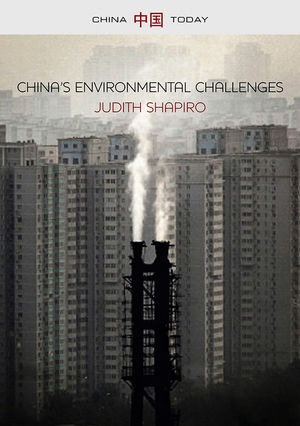
New Book: China's Environmental Challenges By: Judith Shapiro (American University)

China's Environmental Challenges

By: Judith Shapiro (American University)


Description

China’s huge environmental challenges are significant for us all. They affect not only the health and well-being of China but the very future of the planet.

In this trailblazing book, noted China specialist and environmentalist Judith Shapiro investigates China’s struggle to achieve sustainable development against a backdrop of acute rural poverty and soaring middle class consumption. Using five core analytical concepts to explore the complexities of this struggle - the implications of globalization, the challenges of governance; contested national identity, the evolution of civil society and problems of environmental justice and equity - Shapiro poses a number of pressing questions: Do the Chinese people have the right to the higher living standards enjoyed in the developed world? Are China's environmental problems so severe that they may shake the government's stability, legitimacy and control? To what extent are China’s environmental problems due to patterns of Western consumption? And in a world of increasing limits on resources and pollution "sinks," is it even possible to build an equitable system in which people enjoy equal access to resources without taking them from successive generations, from the poor, or from other species?

China and the planet are at a pivotal moment; the path towards a more sustainable development model is still open. But - as Shapiro persuasively argues - making this choice will require humility, creativity, and a rejection of business as usual. The window of opportunity will not be open much longer.

Chapter 1 - 'The Big Picture' - is available online.

Table of Contents

Map Chronology
Preface
Acknowledgments
Chapter One: Introduction: The Big Picture
Chapter Two: Environmental Challenges: Drivers and Trends
Chapter Three: State-led Environmentalism: The View from Above
Chapter Four: Sustainable Development and National Identity
Chapter Five: Public Participation and Civil Society: The View from Below
Chapter Six: Environmental Justice and the Displacement of Environmental Harm
Chapter Seven: Prospects for the Future
References

For more information:  http://www.polity.co.uk/book.asp?ref=9780745660912

Thursday, August 9, 2012

New Publication: Making the Case for Environmental Education in China by Li, Wanxin and Graeme Lang


Making the Case for Environmental Education in China


We examine the effects of schools and parents, the two of the most important sources of influence, on views of human-nature relationship of 6th grade primary school children in China.
Adopting five items of the modified new ecological paradigm scale, we measured both child and his/her parent’s views on human-nature-relationship (HNR). On average, children score higher on the HNR indicators than their parents but both are correlated. Attending a green school and parents’ HNR scores are positively associated with children’s HNR scores. Furthermore, obtaining higher education is associated with parents’ HNR scores, which can be transmitted to children. Thus, the study makes a strong case for more equitable education, and environmental education in particular, that nurtures environmentally friendly worldviews among the future generations in China.

FILES

TYPE OF PUBLICATION

  • Discussion paper

REFERENCE

Li, Wanxin and Graeme Lang, 2012. Making the Case for Environmental Education in China, Working Paper, Department of Public and Social Administration, City University of Hong Kong, and Tsinghua University.